
By
Kevin E. Noonan —
 Ever
Ever
since the Supreme Court handed down its decision in KSR Int'l Co. v.
Teleflex Inc., 550 U.S. 398 (2007), both the U.S. Patent and Trademark Office
and the courts have found it easier to render a decision that a claimed
invention was obvious. While how the USPTO
and the courts have implemented the KSR
obviousness standards have been the subject of some debate, occasionally there
is a case that illustrates that the nuances of the Court's obviousness rubrics
can be applied in such a way that comports with the "common sense"
standard the Court elevated to an analytical tool in KSR.
Such
an instance arose in the application of Doran Adler et al. The case involved an
appeal of a PTO determination that the claims of USSN 10/097,096 to applicants
Doran Adler et al. were obvious. The
invention relates generally to methods and systems for detecting "pathologies
of the gastrointestinal tract"; claim 57 is representative:
57. A method for displaying in-vivo information,
the method comprising:
receiving at a data processor data
generated by a swallowable in-vivo device transversing a GI tract, the data
comprising a set of in-vivo images of the GI tract;
the data processor comparing values
of the received images to a reference value of blood and to a reference value
of healthy tissue;
the data processor causing to be
displayed the imaged as a color video; and
the data processor further, based on
the comparison, causing to be displayed an indication of a position in the GI
tract of a change in the level of red color content, the change correlating to
the presence of blood.
Also
at issue (but not separately argued) was a system claim (claim 63),
substantially comprising a system for practicing the method of claim 57. The cited prior art was the Meron
(WO 00/22975) reference, which discloses a
swallowable camera comprising a "means for sensing the presence of blood"
combined with the Hirata reference (a scientific journal article) that
discloses an endoscopic comparison of normal and healthy esophageal tissues
based on colorometric analysis of esophageal varicies detected by comparing "color
toner and red color sign."
The
PTAB affirmed the Examiner's obviousness rejection, in a non-precedential
decision by APJ Grimes, joined by APJ's Scheiner and Mills, finding that
despite the absence of an express disclosure of the use of the Meron system to detect blood, the
combination of Meron's teachings (that a video camera could be miniaturized and
used to detect GI anomalies "that may be associated with bleeding" in
the GI tract) with Hirata's disclosure that image comparison could be used to
detect changes in the red color spectrum of the GI tract led to a
conclusion of obviousness.
The
Federal Circuit affirmed, in an opinion by Judge Wallach joined by Judges Prost
and Reyna. The panel cited specific
findings of fact that the opinion held were supported by substantial evidence:
12.
Hirata discloses that color tone was analyzed by comparing the color
tone of a defined varices region with the color tone of a defined normal
esophageal region.
13.
Hirata discloses that the area of red color sign was also determined for
a defined varices region.
14.
Hirata discloses that, using image processing, both color tone results and
area of red color sign results could be used to select patients with
varices that have a higher risk of rupture.
(It
was uncontested that the Meron reference teaches a swallowable camera.) The Court found that the Board did not err in
its obviousness determination, and that the Board did not base its obviousness
determination on grounds different from those relied upon by the Examiner
(which would have entitled applicants to a rehearing on the merits). As set forth in the panel's opinion:
The primary issue on appeal is whether the
Board properly found that it would have been obvious in light of the prior art
to compare reference values for healthy tissue and blood to determine whether
images of the gastrointestinal tract showed "a change in the level of red
color content" where that "change correlat[es] to the presence of
blood," as articulated in the claims at issue.
The
appellants argued that their claims embody two comparisons (between patient
images and an image of healthy tissue or between patient images and blood). The Court affirmed the PTO's conclusion that
a "two-prong" assessment as advocated by appellants was merely a "predictable
variation" on the combination of Hirata and Meron and thus unpatentable
for being obvious, citing KSR Int'l Co. v. Teleflex Inc., 550 U.S. 398,
417 (2007) ("If a person of ordinary skill can implement a predictable
variation, § 103 likely bars its patentability."). The opinion rejected appellants' attempts to
distinguish the Hirata reference for failing to teach detection of blood,
stating (in a footnote) that "substantial evidence supports the Board's
finding that Hirata teaches identification of a pathology through red color
image analysis of two reference values" wherein "one of ordinary
skill in the art would understand that detecting areas with different red color
values corresponds to blood."
The
purported "new grounds of rejection" argument was predicated on appellants'
contention that the Board's analysis "changed the thrust of the Examiner's
rejection (Hirata's classification of red color signs); the opinion reproduces
appellants' comparison between the Examiner's grounds of rejection and the
rationale set forth in the PTAB's decision:
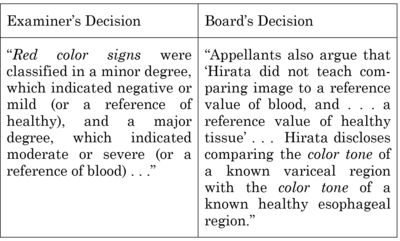
The
court found that appellants did not identify "specific facts found by the
Board but not by the examiner, nor [did they] illustrate[] how any such facts
formed the basis of the Board's rejection." Accordingly:
While the Board's explanation may go into more detail than the examiner's, that
does not amount to a new ground of rejection. See In re Jung, 637 F.3d
1356, 1365 (Fed. Cir. 2011).
In re Adler (Fed. Cir. 2013)
Panel: Circuit Judges Prost, Reyna, and Wallach
Opinion by Circuit Judge Wallach
 Patent Docs
Leave a comment