
By
Donald Zuhn —
Yesterday,
in Biogen Idec, Inc. v. GlaxoSmithKline
LLC, the Federal Circuit affirmed the determination by the District Court
for the Southern District of California that the claim term "anti-CD20
antibody" as used in U.S. Patent No. 7,682,612
was limited by prosecution history estoppel.
The '612 patent is directed to the treatment of hematologic malignancies
associated with circulating tumor cells using anti-CD20 antibodies. Representative claim 1 recites:
1. A method of treating chronic lymphocytic
leukemia in a human patient, comprising administering an anti-CD20 antibody to
the patient in an amount effective to treat the chronic lymphocytic leukemia,
wherein the method does not include treatment with a radiolabeled anti-CD20
antibody.
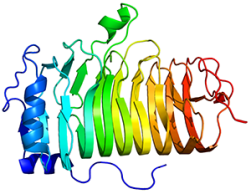 As
As
the majority opinion notes, it was initially believed that only one large loop
(epitope) of the CD20 antigen (at right) was exposed on the surface of cancerous B cells,
and therefore, that there was only one suitable target for the anti-CD20
antibody. However, after Biogen filed
the application that issued as the '612 patent, other researchers discovered
that the CD20 antigen had a second small loop to which certain anti-CD20
antibodies could bind.
During
the prosecution of the application that issued as the '612 patent, the examiner
rejected the claims because the specification did not provide enablement
commensurate with the scope of the claimed invention, which the examiner
contended included "any and all anti-CD20 antibodies, no matter the
specificity or affinity for the specific epitope on the circulating tumor
cells." The examiner acknowledged
that the specification was enabling for Biogen's chimeric gamma 1 anti-human
CD20 antibody, Rituxan® (rituximab), but was silent concerning the specificity
and affinity that would be necessary for other anti-CD20 antibodies. In response to the rejection, Biogen stated
that:
[E]ven though antibodies directed to the same
antigen might have different affinities and functional characteristics, one of
skill in the art could readily identify an antibody that binds to CD20 with
similar affinity and specificity as does RITUXAN® using techniques that are
well known in the art. . . . With that knowledge in hand, the skilled
artisan could readily produce anti-CD20 antibodies using similar techniques,
and screen such antibodies for those having an affinity and functional activity
similar to RITUXAN®.
The
examiner then withdrew the rejection and allowed the application.
 In
In
March 2010, Biogen filed suit against GlaxoSmithKline, asserting that GSK's
anti-CD20 antibody Arzerra® (ofatumumab) infringed claims 1-4, 6, 8-10, 14-17,
20-22, and 58-60 of the '612 patent. In
contrast with Rituxan®, Arzerra® binds to the second small loop of the CD20
antigen, has a much greater affinity for the CD20 antigen, and is a fully human
antibody. The District Court conducted a
Markman hearing to construe three
terms, including the term "anti-CD20 antibody." The District Court rejected Biogen's broad
construction of "an antibody that binds to a cell surface CD20
antigen," and instead adopted GSK's construction "rituximab and
antibodies that bind to the same epitope of the CD20 antigen with similar
affinity and specificity as rituximab."
In adopting the latter construction, the District Court noted that prosecution
history disclaimer applied because Biogen had limited the term to overcome the
examiner's enablement rejection.
Following this construction, Biogen stipulated to noninfringement and
appealed the District Court's construction to the Federal Circuit.
 Writing
for the majority, Judge Reyna notes that because neither the claims nor the
specification compelled a construction that was contrary to the one offered by
Biogen, the question before the Court was whether statements in the prosecution
history were sufficient to overcome the heavy presumption that the term "anti-CD20
antibody" carries its full ordinary and customary meaning. The majority concludes that Biogen's
statements during prosecution were sufficient.
In particular, the majority observes that:
[R]ather than challenging the examiner's understanding
of the crucial terms, the applicants argued that the specification was enabling
for anti-CD20 antibodies with similar affinity and specificity as Rituxan®. Indeed, the applicants conceded that other
"antibodies directed to the same antigen [i.e., CD20] might have different
affinities and functional characteristics," and limited their claims to
antibodies similar to Rituxan® nonetheless.
. . . [I]t is clear that they
were limiting their invention to what the examiner believed they enabled:
antibodies that have a similar specificity and affinity for the specific
epitope to which Rituxan® binds.
The
majority also found both of Biogen's arguments regarding why the plain and ordinary
meaning of the term should control to be unpersuasive. First, in response to Biogen's argument of
claim differentiation (that claim 1 broadly covers any and all anti-CD20 antibodies
and several dependent claims are directed to specific types of antibodies, i.e., chimeric, rituximab, humanized,
and human), the majority counters that "[o]ur cases make clear . . . that
where found, prosecution history disclaimer can overcome the presumption of
claim differentiation." In response
to Biogen's second argument that the '612 patent incorporates U.S. Patent No.
5,736,137,
and that the '137 patent's broader definition of "anti-CD20 antibody"
should control, the majority states that "[t]he problem with this argument
is that the '137 patent expressly and uniquely defines 'anti-CD20 antibody' for
use therein, that is, within the '137 patent."
Writing
in dissent, Judge Plager states that "[b]ecause I do not find anywhere in
the majority opinion or in the prosecution history that clear and unmistakable evidence
of a disclaimer as required by our precedents, I cannot agree with the majority
that such a disclaimer was made by Biogen during the prosecution of its
application for the '612 patent."
Noting that "[t]he only dispute is whether the applicants disclaimed
the plain meaning of 'anti-CD20 antibody' during prosecution," Judge
Plager states that "[t]he majority purports to tease out of the
prosecution history such a disclaimer."
The dissent continues:
Nowhere in the prosecution history did the
applicants state that antibodies that bind to the same epitope on CD20 with
similar affinity and specificity as RITUXAN® must be used, or that antibodies
lacking those characteristics must not be used.
To the contrary, the applicants repeatedly made clear — including in
the same discussion as the allegedly disclaiming statement — that because the invention
was based on the discovery that anti-CD20 antibodies could treat CLL, the
claimed methods were not limited to the use of any particular type anti-CD20
antibody.
"Because
the district court's construction eviscerates the 'clear and unmistakable' requirement
for prosecution disclaimer," Judge Plager states that he "cannot join
the majority in affirming that erroneous construction."
Biogen Idec, Inc. v.
GlaxoSmithKline LLC
(Fed. Cir. 2013)
Panel:
Circuit Judges Dyk, Plager, and Reyna
Opinion
by Circuit Judge Reyna; dissenting opinion by Circuit Judge Plager

 Patent Docs
Leave a comment