
By Donald Zuhn —
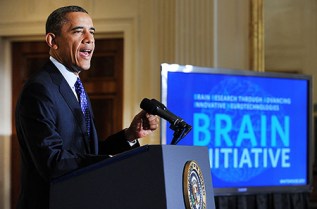 Last week, President Obama announced
a new research initiative designed to advance our understanding of the human brain. It is hoped that the new initiative, dubbed the
BRAIN (Brain Research through Advancing
Innovative Neurotechnologies) Initiative, will lead to new methods for treating,
curing, and preventing brain disorders such as Alzheimer's disease, Parkinson's
disease, autism, epilepsy, schizophrenia, depression, and traumatic brain
injury. The initiative, one of the
Administration's "Grand Challenges," aims to produce a dynamic
picture of the brain that will show how individual cells and complex neural
circuits interact in both time and space, thereby providing opportunities for
exploring exactly how the brain enables the human body to record, process, utilize,
store, and retrieve vast quantities of information.
In announcing the new
initiative, the Administration noted that despite recent advances in
neuroscience, the underlying causes of most neurological and psychiatric
conditions remain largely unknown, due to the vast complexity of the human
brain. According to the White House
release, significant breakthroughs in the treatment of neurological and
psychiatric disease will require a new generation of tools that enable
researchers to record signals from brain cells in much greater numbers and at
even faster speeds.
The new initiative is still
in the planning process, however, with a working group of the Advisory
Committee to the NIH Director having been formed to articulate the scientific
goals of the BRAIN initiative and develop a multi-year scientific plan for
achieving those goals. The working group
will produce an interim report by the fall of this year that will contain
specific recommendations on high priority investments for FY 2014, with a final
report to be delivered to the NIH Director in June 2014.
Beginning in FY 2014, the National
Institutes of Health (NIH), Defense Advanced Research Projects Agency (DARPA),
and National Science Foundation (NSF) will provide some $100 million in funding
to support the initiative. DARPA's role
in the initiative will be to develop a new set of tools to capture and process
dynamic neural and synaptic activities, while the NSF will support research
spanning biology, the physical sciences, engineering, computer science, and the
social and behavioral sciences, and in particular, will develop molecular-scale
probes that can sense and record the activity of neural networks, work on
advances in "Big Data" that will be required to analyze the huge
amounts of information that will be generated, and aid in the understanding of
how thoughts, emotions, actions, and memories are represented in the brain. Private foundations, including the Howard
Hughes Medical Institute, the Allen Institute for Brain Science, The Kavli
Foundation, and the Salk Institute for Biological Studies have also made
commitments to support the new initiative.
In seeking additional
support for the BRAIN initiative, the Administration noted that a previous
Grand Challenge, the Human Genome Project, demonstrated that ambitious research
projects can have a significant impact on the country's economy. With respect to the Human Genome Project, for
example, the Federal Government invested $3.8 billion in that initiative
between 1988 and 2003, producing an economic output of $796 billion, or a return
of $14 for every $1 invested (see
"Report Gauges Economic Impact of
Human Genome Project").
 Patent Docs
Leave a comment