
By Michael Greenfield —
 Those of you who dabble with chemical structures
while prosecuting or litigating pharmaceutical patents may find Allergan v. Barr Laboratories, Inc.,
interesting. In this ANDA litigation
brought by Allergan against Barr, Teva, and Sandoz ("Barr"), the
Federal Circuit opined on issues of claim construction and obviousness with
respect to Allergan's Lumigan®, an ophthalmic solution used to treat high
eye pressure in people with open-angle glaucoma or ocular hypertension. The
active ingredient in Lumigan® is bimatoprost (cyclopentane N-ethyl
heptenamide-5-cis-2-(3α-hydroxy-5-phenyl-1-trans-pentenyl)-3, 5-dihydroxy,
[1α,2β,3α,5α]):
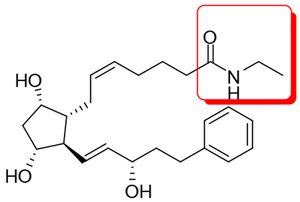
(The ethyl amide moiety in the red square is where
all the action was focused in the case.) Allergan asserted claim 10 of U.S. Patent No. 5,688,819 ("the '819 patent"), which recited a method of treating
ocular hypertension or glaucoma with a compound selected from a Marksuh group
of five compounds listed by their chemical name. Bimatoprost was one of them.
Claim Constructions
Barr had argued that bimatoprost did not fall within the scope of
claim 5, from which claim 10 ultimately depended. Claim 5 recited a method of
treating ocular hypertension or glaucoma using a compound of formula

where Z can be =O and X can be –N(R4)2,
"wherein R4 is selected from the group consisting of hydrogen,
a lower alkyl radical having from one to six carbon atoms . . . ." The issue was
framed as whether claim 5 encompassed compounds in which the two R4
moieties of "-N(R4)2" must be identical or
could differ (as required by bimatoprost, where one R4 moiety must
be hydrogen and the other C2-alkyl). Both the District Court and the
Federal Circuit held that claim 5 encompassed compounds in which the R4
moieties were non-identical.
 Barr argued that the plain meaning of "-N(R4)2"
required identical R4 moieties, relying on extrinsic evidence such
as, for example, expert testimony that "[t]he (X)y nomenclature"
was "commonly used" to represent identical substituents. The Federal
Circuit was unpersuaded, relying heavily on Phillips
v. AWH Corp. for the proposition that claim terms are to be given the
meaning as one of ordinary skill in the art would understand them in the
context of how they are used in the patent at issue and concluding, "[t]he
inventor's lexicography governs when the specification reveals a special
definition given to a claim term by the patentee that differs from the meaning
it would otherwise possess."
In arriving at the conclusion that "-N(R4)2"
encompassed compounds in which the R4 moieties were non-identical,
the Court pointed to the fact that of the five compounds recited in claim 10
(which, you'll remember, depended from claim 5), three (including bimatoprost)
possessed an "-N(R4)2" moiety having
non-identical R4 moieties. The Court also noted that same
relationship between claim 18 (which recited the same three compounds) and
claim 11 (which recited a method of treating other diseases using compounds
defined in the same manner as claim 5. (It's of some interest to note that the
specification used the exact same language at issue in the claims.) And,
finally, the Court noted that the specification disclosed the same three
compounds as useful in the pharmaceutical compositions and methods of the
invention. The Court held that in this context the patent clearly manifested that
"-N(R4)2" encompassed compounds with non-identical
R4 moieties.
Practice tip: Save yourself a lot of heartache and
your client a lot of money, and in these situations define R4 more
clearly, such as, "each R4 is independently selected from . . . ."
Obviousness
The Federal Circuit next considered the Barr's
assertion that claim 10 (the method of treating glaucoma using one of bimatoprost or
four other compounds) was obvious, first (a) dismissing the credibility of the defendants'
expert, who was described as being "eviscerated" (ouch!) on cross
examination and whose testimony was "flawed on a fundamental level"
and (b) determining that the nature of the involved technology did not lend
itself to lay interpretation, but required expert testimony. This appears to
have left Barr in the position of having to rely on the plaintiff's experts, an
uncomfortable position, one imagines, at best. As explained below, and not
surprisingly, the defendants were unable to extract the support they needed to
carry their burden of proving the claim obvious.
Barr asserted that bimatroprost was obvious over the
isopropyl ester analog of compound 2 of Stjernschantz (WO 90/02253 [sic, WO
90/02553]),

which was disclosed as useful for treating the very
same conditions as bimatoprost. The defendants argued that the plaintiff's
expert testimony supported three facts necessary to establish obviousness:
(1) Stjernschantz taught that bimatoprost-free
acid lowered intraocular pressure;
(2) Stjernschantz's
compound 2 hydrolyzed into bimatoprost-free acid when placed in the eye; and
(3) a
skilled artisan would have known that substituting an amide for the ester at
the C-1 position would result in a prodrug that hydrolyzed into
bimatoprost-free acid in the eye.
In not so many words, the Federal Circuit held, "close,
but no cigar," finding that although Allergan's expert testimony supported
the first two points, the testimony in fact contradicted the third point. Allergan's expert testified that an amide (such as found in bimatoprost) converts
into a carboxylic acid at such a low rate ("500-year half life" of an
amide in water) that one of ordinary skill in the art would not have considered
it as a prodrug. With Barr left empty-handed expert-wise, Allergan's expert
opinion prevailed, and the Federal Circuit upheld the District Court's finding that
claim 10 was not invalid as obvious.
Allergan,
Inc. v. Barr Laboratories, Inc. (Fed. Cir. 2013)
Panel: Chief Judge Rader and Circuit Judges Bryson
and Wallach
Opinion by Circuit Judge Wallach


 Patent Docs
Leave a comment