
By Donald Zuhn —
 Reflecting upon the events
of the past twelve months, Patent Docs
presents its sixth annual list of top biotech/pharma patent stories. For 2012, we identified fifteen stories that were
covered on Patent Docs last year that
we believe had (or are likely to have) the greatest impact on biotech/pharma
patent practitioners and applicants. On
Monday
and Tuesday,
we counted down stories #15 to #8, and today we count down stories #7 to #4 as
we work our way towards the top three stories of 2012. As with our other lists (2011, 2010, 2009, 2008, and 2007), links to our coverage of these stories (as well as a few links
to articles on related topics) have been provided in case you missed the
articles the first time around or wish to go back and have another look. As always, we love to hear from Patent Docs readers, so if you think we
left something off the list or disagree with anything we included, please let
us know.
7. Federal
Circuit Interprets § 271(e)(1) Safe Harbor as Extending to Post-approval
Activities
In a case involving whether
certain post-approval activities fall within the "safe harbor" of 35
U.S.C. § 271(e)(1), a divided panel of the Federal Circuit in August vacated a
preliminary injunction granted by the District Court, holding that acts taken
after approval fell with the safe harbor.
According to the majority, it was significant that Congress had not
(expressly) limited the scope of the safe harbor to the Food, Drug and Cosmetic
Act but had "broadly" included within the scope of the safe harbor
"any federal law" that "regulates the manufacture, use, or sale
of drugs." Thus, the majority
rejected Momenta's contention that the process and quality control information
obtained from Amphastar's infringement was not submitted to the FDA but was retained
by defendants, as these "batch records" must be maintained "for
at least one year after expiration of the batch" of generic enoxaparin and
must be "readily available for authorized inspection" by the
FDA."
The majority opinion states that "[w]e therefore hold that
post-approval studies that are 'reasonably related to the development and
submission of information under a Federal law which regulates the manufacture,
use, or sale of drugs' fall within the scope of the § 271(e)(1) safe
harbor." Momenta's request for
rehearing en banc was denied by the
Federal Circuit in November.
For information regarding
this and other related topics, please see:
• "Momenta Pharmaceuticals Inc. v. Amphastar
Pharmaceuticals, Inc.: 'The Rest of the Story,'" August 13, 2012
• "Momenta Pharmaceuticals, Inc. v. Amphastar
Pharmaceuticals, Inc. (Fed. Cir. 2012)," August 9, 2012
• "Chief Judge Rader
(Not Surprisingly) Gets it Right about Chimerical 'Tragedy of the Anti-Commons,'"
August 6, 2012
6.
Implementation of Biosimilar Regulatory Pathway Proceeds Despite
Opposition
In February, the U.S. Food
and Drug Administration published its long-awaited draft guidance on the
development of biosimilar products. The FDA's guidance consisted
of three documents: Scientific
Considerations in Demonstrating Biosimilarity to a Reference Product, Quality
Considerations in Demonstrating Biosimilarity to a Reference Protein Product,
and Biosimilars: Questions and Answers Regarding Implementation of the
Biologics Price Competition and Innovation Act of 2009. The FDA then spent the next few months
collecting comments regarding the draft guidance, and in May held a hearing on
the draft guidance, where researchers, payors, patient and physician groups,
and industry advocates provided their thoughts on the FDA's first attempt to
clarify the logistics as to the operation of the BPCIA. The FDA's efforts to implement the BPCIA,
however, did not push implementation of the biosimilar regulatory pathway up to #6
on this year's list. No, it was the
Supreme Court's landmark decision in June upholding the Patient Protection and
Affordable Care Act (PPACA) — of which the BPCIA is a part — as
constitutional under the taxation clause of the Constitution that lifted this
topic to #6. While the Supreme Court's
decision in National Federation of Independent Business v. Sebelius did
not constitute a direct challenge to the BPCIA, there were a handful of direct
challenges to aspects of the BPCIA. For example,
President Obama took yet another shot at the 12-year data exclusivity period
specified under the BPCIA in his 2013 budget proposal, calling for a
modification of the length of exclusivity to facilitate faster development of
generic biologics by "award[ing] brand biologic manufacturers seven years
of exclusivity rather than 12 years under current law." The same modification had been included in
the President's 2012 budget proposal. In
addition, Abbott filed a Citizen Petition with the FDA in April, requesting
that the agency refrain from accepting biosimilar applications under the BPCIA
that cite reference products (biologics) for which a biologics license
application (BLA) was submitted to the FDA prior to March 23, 2010 (when the
PPACA was signed into law).
Interestingly, in a letter to the FDA, Rep. Anna Eshoo (D-CA), who was one of the principal
authors of the BPCIA, stated that "[w]hile Abbott's Citizen Petition
argues that pre-BPCIA approved biologic products cannot be subject to the law,
l want to state very emphatically that it was Congressional intent for the new
pathway to apply to biologics approved before and after the passage of the
Affordable Care Act." In October,
the FDA sent a letter to Abbott noting that the agency "has been unable to
reach a decision on [Abbott's] petition because it raises complex issues
requiring extensive review and analysis by Agency officials." The agency did not provide a date by which it
would respond.
For information regarding
this and other related topics, please see:
• "Rep. Eshoo Expresses
Views on Abbott's Biosimilars Petition in Letter to FDA," October 25, 2012
• "FDA Continues to
Review Abbott Petition on Biosimilars," October 24, 2012
• "Affordable Care Act
Survives Supreme Court Review Largely Unscathed, Clearing Way for Biosimilars,"
June 28, 2012
• "BIO International
Convention 2012 Preview – Part II: BIO and Biosimilar Regulations throughout
the World," June 12, 2012
• "House Passes User
Fee Bill," May 31, 2012
• "Senate Passes User
Fee Bill," May 29, 2012
• "FDA Holds Public
Hearing on Biosimilar Draft Guidance," May 20, 2012
• "BIO Comments on FDA
Biosimilars Guidance: Demand More Testing, Permit Fewer Differences,"
April 25, 2012
• "Abbott Asks FDA to
Refuse Certain Biosimilar Applications," April 23, 2012
• "FDA Discusses
Initial Considerations for Biosimilar Guidance Documents," February 27,
2012
• "President's Latest
Budget Proposal Seeks Decrease of Data Exclusivity Period and Elimination of
Pay-for-Delay Agreements," February 21, 2012
• "More on FDA Draft
Guidelines for 'Follow-on' Biologic Drug Approval Pathway,"
February 14, 2012
• "FDA Publishes Draft
Guidelines for Biosimilar Product Development," February 9, 2012
5. Federal
Circuit Confirms Patent Eligibility of Isolated DNA
In August, the Federal
Circuit in Association for Molecular
Pathology v. U.S. Patent and Trademark Office, decided on remand that, the Supreme Court's decision in Mayo v. Prometheus notwithstanding, claims to isolated human DNA
satisfy the requirements of 35 U.S.C. § 101.
Each of Judge Lourie's majority opinion, Judge Moore's concurring
opinion, and Judge Bryson's opinion concurring in part and dissenting in part
substantially tracked their opinions when the panel first decided AMP v. USPTO.
Had the case ended here, the Federal Circuit's decision would have
placed higher on our list (perhaps foreshadowing one of the stories to be discussed in the final installment of our Top Stories series).
For information regarding
this and other related topics, please see:
• "Patent Eligibility
and Biology," August 23, 2012
• "Association for Molecular Pathology v.
United States Patent and Trademark Office (Fed. Cir. 2012)," August
16, 2012
• "AMP v. USPTO — Federal Circuit Confirms
Patent Eligibility of Isolated DNA," August 16, 2012
• "The Proper Scope of
DNA (or "Gene") Patent Claims," August 1, 2012
• "Myriad and Prometheus: Do Patents 'Preempt' Follow-On Research?" July 29,
2012
• "Federal Circuit
Hears Oral Argument in AMP v. USPTO
Remand," July 23, 2012
• "Myriad Genetics
Files Supplemental Brief in AMP v. USPTO,"
July 19, 2012
• "Supplemental Brief
for Appellees in AMP v. USPTO,"
July 19, 2012
• "Biopharmaceutical
Companies Weigh-In on Myriad
Case," July 17, 2012
• "Health Care
Professionals Contend That Isolated DNA and cDNA Are Patent Ineligible,"
July 16, 2012
• "Coalition of Amici File Brief in Support of
Myriad," July 15, 2012
• "Dr. James Watson:
Human Genes Should Not Be Patented," July 12, 2012
• "Scientist-Law
Professor Files Amicus Brief in Myriad Case," July 11, 2012
• "U.S. Government: Mayo Decision Supports Prior Argument
That Isolated Genomic DNA Is Not Patent Eligible," July 10, 2012
• "IPO Amicus Brief Argues for Patent
Eligibility of Myriad's Isolated DNA Claims and Method Claim 20," July 9,
2012
• "Eli Lilly & Co.
File Amicus Brief in AMP v. Myriad," June 27, 2012
• "Biotech Companies
Send Letter on Myriad Case to
Attorney General and Solicitor General," June 19, 2012
• "Parties and Amici File Briefs in Myriad Case," June 17, 2012
• "The Aussies Are At
It Again," June 14, 2012
• "Federal Circuit
Declines Invitation to Reconsider Standing Question," June 13, 2012
• "Plaintiffs Respond
to Myriad's 'Suggestion' of Mootness or, Alternatively, Motion for Remand in AMP v. USPTO," June 10, 2012
• "Myriad Files Motion
'Suggesting' Mootness or Seeking Remand in AMP
v. USPTO," May 30, 2012
• "Federal Circuit
Sets Schedule for AMP v. USPTO,"
April 30, 2012
• "Supreme Court
Remands Myriad Case," March 26,
2012
4. Supreme
Court Grants Certiorari in Monsanto v.
Bowman
In October, the Supreme
Court granted certiorari in Monsanto v. Bowman, against the advice
of the U.S. Solicitor General. In Bowman, Monsanto's complaint arose from
farmer Bowman's "second planting" of herbicide resistant seed that
was made using so-called "commodity seed" (seed sold by farmers to
local grain elevators for commodity use, for example, as cattle feed). After planting this seed, which was
significantly cheaper than Roundup Ready® seed, farmer Bowman tested the crop
for Roundup® resistance and found that substantial amounts of the seed were
resistant. He used Roundup® on these
plantings and then replanted the seed.
The District Court granted summary judgment of patent infringement and
entered judgment against farmer Bowman, and the Federal Circuit affirmed. The question presented to the Supreme Court
is:
Whether the Federal Circuit erred by (1)
refusing to find patent exhaustion in patented seeds even after an authorized
sale and by (2) creating an exception to the doctrine of patent exhaustion for
self-replicating technologies?
For information regarding
this and other related topics, please see:
• "Supreme Court
Grants Certiorari in Monsanto v. Bowman,"
October 22, 2012
• "Bowman Responds to
Solicitor General," September 12, 2012
• "Solicitor General
Recommends the Supreme Court Deny Cert in Bowman
v. Monsanto," August 30, 2012
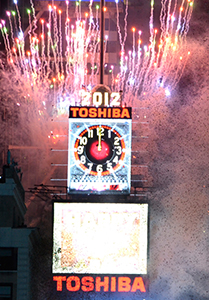
Image of New Year's Eve
ball drop for 2012 in Times Square
(above) by Replytojain, from the Wikipedia Commons under the Creative Commons
Attribution-ShareAlike 3.0 Unported
license.

 Patent Docs
Leave a comment