
By Donald Zuhn —
 Last week, the U.S. Patent
and Trademark Office published a notice in the Federal Register (77 Fed. Reg.
72830) seeking
public feedback on Request for Continued Examination (RCE) practice. The notice indicates that the Office
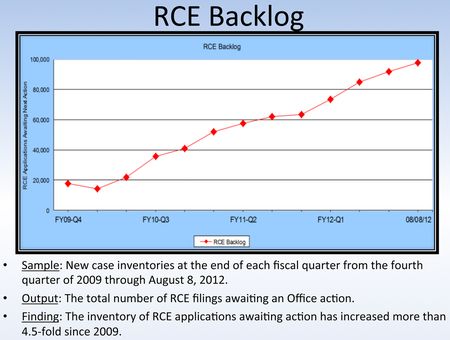
currently has a backlog of more than 90,000 applications that have not been
examined since an RCE was filed, and states that this backlog diverts Office
resources from the examination of new applications. While the Office notes that several programs
have been implemented to reduce the need to file an RCE, and thereby reduce the
RCE backlog, the Office is now turning to its stakeholders "in an effort
to better understand the full spectrum of factors that impact the decision to
file an RCE." The Office plans to
use the information it gathers to design additional programs and initiatives
aimed at reducing RCE filings and the RCE backlog.
The
Office describes some of its efforts to reduce the RCE backlog in the notice,
pointing to the Quick Path Information Disclosure Statement (QPIDS) pilot
program and the After Final Consideration Pilot (AFCP) as two examples (see
"USPTO Announces Quick Path Information Disclosure Statement (QPIDS) Pilot
Program";
"USPTO to Assess After Final Consideration Pilot Program";
and "USPTO News Briefs,"
June 21, 2012). The notice does not, however, discuss the Office's efforts to decrease RCE filings by raising the cost of
filing a first RCE to $1,200 (from the current fee of $930), and further raise
the cost of filing subsequent RCEs to $1,700 (see "More on USPTO's
Proposed New Fees – Part II"),
a proposal that the Patent Public Advisory Committee (PPAC) has called
"illogical" (see "PPAC Issues Report on USPTO Patent Fees
Proposal"). On the topic of RCE filings, PPAC has
previously explained that:
[A]pplicants rely on RCEs to continue the
prosecution and eventually (and justly) receive a patent on their
invention. RCEs are mostly filed by applicants genuinely attempting to
move prosecution forward and get a patent and not generally, it is believed,
simply to delay the prosecution (applicants have the ability to file further
continuation applications to proceed with other claim sets or to keep a
particular patent family in prosecution in any case). RCEs are a source
of frustration for both the Office and the applicants, with both parties
contributing to the problem. However, from both casual conversation and
also in public statements, the USPTO seems to place the blame for the rapid
growth in RCE applications solely and squarely on applicants. The change
several years ago to move RCEs to the special new case docket (rather than an
examiner’s amended docket) causes (as one would expect) significant delays in
acting on RCEs. That the Office has proposed significant increases in the
RCE fees adds salt to an existing wound: applicants must pay more for
what most perceive as a reduction in service. Thus, the proposed increase
in fees for RCEs was not well received by the public.
Noting
that "[t]he USPTO acknowledges that the cost of completing an RCE is less
than that required for an original utility application," PPAC has also
contended that "the increased costs to applicant being proposed to treat
an RCE (and particularly a second and subsequent RCE) compared to the fees
proposed for a utility or continuation application seems illogical."
Instead, PPAC has suggested that:
[A] small increase in the fee for an RCE
might be appropriate but it should align more closely to the associated
required work, and certainly be less than the fees for new or continuation
applications. The higher fee for second and subsequent RCEs should be
eliminated because these become easier and cheaper to examine and any number of
continuations may be filed at the same cost per continuation. Rather than
punishing applicants for pursuing their inventions by filing an RCE, it is
suggested that the USPTO continue to find ways to reduce applicants' need for
the RCEs in the first place.
The
Office's request for comments on RCE practice also notes that a webpage
devoted to its efforts to decrease the RCE backlog has been created on the
USPTO website. Data regarding RCE
filings can be found at this webpage, including a chart showing the rise in the
RCE backlog from just under 20,000 RCE filings awaiting an Office action in the
fourth quarter of fiscal year (FY) 2009 to the current level of nearly 100,000.
The
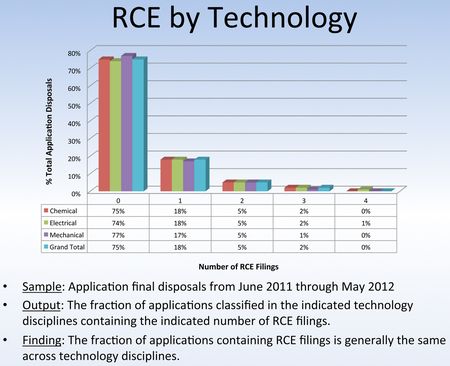
Office also provides data on RCE filings by technology, noting that the
fraction of applications containing RCE filings is generally the same across
technologies.
According to the notice,
the public can provide feedback regarding RCE practice by submitting written
comments by e-mail to rceoutreach@uspto.gov;
by regular mail to the United States Patent and Trademark Office, Mail Stop
Comments — Patents, Office of Commissioner for Patents, P.O. Box 1450, Alexandria,
VA 22313–1450, marked to the attention of Raul Tamayo; or using the web-based
collaboration tool IdeaScale®, which
allows users to post comments, view and respond to others' comments, and indicate
agreement or disagreement with particular comments. Comments must be submitted by February 4, 2013. The Office also plant to hold a series of
roundtables on RCE practice.
The
notice provides a series of questions on which the Office is particularly seeking comment:
(1) If within your practice you file a
higher or lower number of RCEs for certain clients or areas of technology as
compared to others, what factor(s) can you identify for the difference in
filings?
(2)
What change(s), if any, in Office procedure(s) or regulation(s) would reduce
your need to file RCEs?
(3)
What effect(s), if any, does the Office’s interview practice have on your
decision to file an RCE?
(4)
If, on average, interviews with examiners lead you to file fewer RCEs, at
what point during prosecution do interviews most regularly produce this effect?
(5)
What actions could be taken by either the Office or applicants to reduce the
need to file evidence (not including an IDS) after a final rejection?
(6)
When considering how to respond to a final rejection, what factor(s) cause
you to favor the filing of an RCE?
(7)
When considering how to respond to a final rejection, what factor(s) cause
you to favor the filing of an amendment after final (37 CFR 1.116)?
(8)
Was your after final practice impacted by the Office’s change to the order
of examination of RCEs in November 2009? If so, how?
(9)
How does client preference drive your decision to file an RCE or other
response after final?
(10)
What strategy/strategies do you employ to avoid RCEs?
(11)
Do you have other reasons for filing an RCE that you would like to share?
 Patent Docs
Leave a comment