
By Kevin E. Noonan —
Mimicry
is a classic (and classical) biological phenomenon, the appreciation of which
dates to the time when biology was more accurately called "natural history"
and was more diversion for English country gentlemen than proper science. Perhaps
the most well-known form of mimicry is Müllerian mimicry, and the
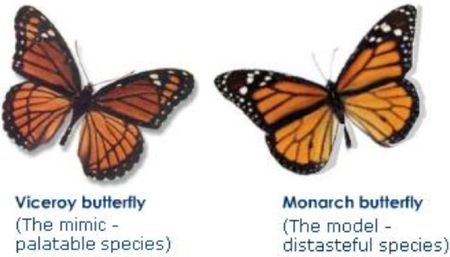
best example of that is the viceroy butterfly (Limenitis
archippus),
which although tasty to avian predators displays markings almost
indistiguishable from the monarch butterfly (Danaus
plexippus),
which is not only unpalatable but actually toxic to birds (see below). Anyone with even a rudimentary appreciation
of Linnean classification will recognize another interesting feature of
mimicry: despite their visual similarities, the monarch and viceroy butterflies
are not only different species but members of different genera, suggesting that
genetic inheritance cannot account for the convergence in wing pattern
phenotype.
 Recent
work employing genomic sequencing and linkage analysis (from the Heliconius
Genome Project) has begun to shed light on the genetic bases for Müllerian
mimicry. This work was performed on a
South American butterfly species, Heliconius
melpomene (at right). As reported in Nature (doi:10.1038/nature11041), naturally occurring species of Heliconius show significant
introgression in regions related to color pattern development. Heliconius butterflies comprise 43 species and
hundreds of races and make up rapidly radiating butterfly species in South
America; certain of these species exhibit classic Müllerian mimicry, wherein palatable species adopt the
color pattern of other species that are unpalatable to bird predators. The
authors sequenced almost 13,000 genes (12,669 open reading frames) in the 269
megabase (Mb) butterfly genomic DNA and mapped the majority (~83%) of these
genes to the 21 Heliconius chromosomes using a modern
version of RFLP analysis termed restriction site DNA linkage mapping. This work
found that the chromosomal organization of Heliconius butterfly genomic DNA was "broadly
conserved"
since the evolutionary split from a common ancestor shared with Bombyx (silkmoth) species in the
Cretaceous (~100 million years ago). Comparison
with the Bombyx mori (silkmoth) genome
identified 6,010 orthologues and previously unidentified chromosomal fusions in
the Heliconius chromosomal
complement. Biologically important expansion was found in families of
genes related to chemosensation and body shape and form (homeobox, or Hox, genes). The Heliconius genome showed an
expected increase in ultraviolet opsins (due to the diurnal lifestyle adopted
by butterflies) and an unexpected genetic complexity in olfactory genes (33 Heliconius
olfaction genes, similar to what was found in monarch butterfly species having
34 olfactory genes). The researchers also
found additional Hox genes related to body shape and form, similar to
what is found in other butterflies and related dipteran species.
The
researchers compared genomic DNA from three co-mimicry species, Heliconius melpomene, Heliconius timareta, and Heliconius
elevatus and produced a genetic tree between 84 individuals from H.
melpomene and related species (see below). In
this comparison, the researchers found hybrid exchange especially at two genomic regions that control mimicry
pattern based on ~4% (12Mb) of the
genome. The results obtained from Heliconius melpomene amaryllis
and H. timareta ssp. were
compared and the researchers report evidence of greater hybrid interbreeding
between these species when compared with H.
melpomene aglaope and H. timareta ssp, which do not
have overlapping spatial ranges. The
researchers estimated 2-5% exchange of the genome; the introgression was not
uniformly distributed over the 21 chromosomes but seems to be limited to 11
chromosomes with two chromosomes showing the strongest frequency of
introgression. These regions, comprising loci known to be associated with red pattern (B/D) and yellow (N/Yb) pattern loci, showed blocks of sequence (~100 kb in size) that are
shared between species and exchanged in hybrids. The genetic makeup of these shared blocks of
sequence were more consistent with hybrid introgression (and fixation) than in
other alternatives, such as convergent evolution.

The researchers concluded that these species
exchange protective color pattern genes promiscuously and that their evidence
of hybrid exchange and fixation indicates that this mode of gene transfer
between diverse species may be a more important mechanism for explaining
phenomena like mimicry than had been previously appreciated. The authors propose that hybridization
between mimicking species is a plausible explanation for "parallel
evolution of multiple mimetic patterns" in these species.
Supplemental
experimental details can be found here.
Image of Heliconius melpomene by Greg Hume, from the Wikipedia Commons under the Creative Commons Attribution-ShareAlike 3.0 Unported license.

 Patent Docs
Leave a comment