
By Kevin E. Noonan —
The Karolinska Institute announced today that the Nobel Prize in Physiology and Medicine was awarded to Robert G. Edwards for his work in developing in vitro fertilization (IVF) in humans.
The Institute's press release announcing the prize noted that this work began in the 1950's, finally reaching success on July 25, 1978 when the first human child was born as a result of his methods. Since then, it is estimated that approximately four million "test tube babies" have been born worldwide as the result of IVF. The method has helped the estimated 10% of couples who are infertile, and started a "new field of medicine," according to the Karoliniska.
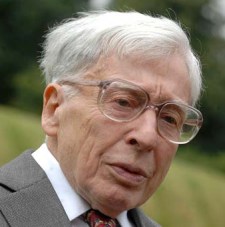 Dr. Edwards's (at left) IVF work was not a simple application of principles that had worked with animal embryos, however. As the explanation of his work explains, Dr. Edwards "made a number of fundamental discoveries" on human egg cell development and how it differs from animal (rabbit) eggs that had been previously fertilized in vitro, including hormonal influences and the conditions and timing for both sperm and egg to facilitate fertilization. Significantly for the development of the method, Dr. Edwards found that eggs that had matured in vivo were required for the in vitro fertilized egg to develop past the zygote stage.
While not naming him as a co-recipient, the Institute recognized Dr. Patrick Steptoe, a gynecologist whose contributions helped Dr. Edwards to develop IVF "from experiment to practical medicine." This involved application to Steptoe's skills in laparoscopy, which was a new technique at the time, to harvest eggs from ovaries in vivo that Edwards then used for IVF. This was the work that led to the birth of Louise Brown (at right), the first test tube baby in 1978.
The references cited by the Nobel Committee for this work are:
• Edwards RG, "Maturation in vitro of human ovarian oocytes," Lancet 2: 926-29 (1965).
• Edwards RG, Bavister BD, Steptoe PC, "Early stages of fertilization in vitro of human oocytes matured in vitro," Nature 221: 632-35 (1969).
• Edwards RG, Steptoe PC, Purdy JM, "Fertilization and cleavage in vitro of human oocytes matured in vivo," Nature 227: 1307-09 (1970).
• Steptoe PC, Edwards RG, "Birth after the reimplantation of a human embryo," Lancet 2: 366 (1978).
• Edwards RG, "The bumpy road to human in vitro fertilization," Nature Med. 7: 1091-94 (2001).
This work was not patented, and in view of the times, the use of human embryos, and the uncertainties of the procedures this is perhaps not surprising. This technology is one amenable to other means of intellectual property protection, and at least initially it was difficult if not impossible for others to practice this technology merely by reading research articles — it required the expertise and experience Drs. Edwards and Steptoe had developed to reliably use a test tube to make a baby. Their experience, even if exercised merely to ensure that the technology was properly used may be instructive for other areas (like genetic diagnostics) that may need alternatives to patent protection as the science and law evolve over the next several years.
Photos of Dr. Edwards and Louise Brown from "Robert G. Edwards – Photo Gallery," Nobelprize.org, 5 Oct. 2010 <http://nobelprize.org/nobel_prizes/medicine/laureates/2010/edwards-photo.html>.


 Patent Docs
Leave a comment