
By Kevin E. Noonan —
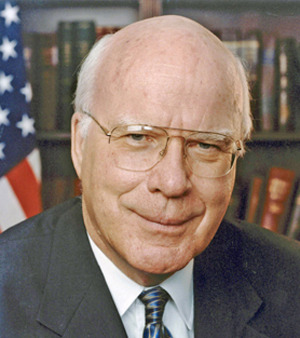 "Politics," according to Otto von
Bismarck, "is the art of the possible." And thus it is possible that a patent reform bill
will, against all odds, be passed by this session of Congress. But that is only if Senator Patrick
Leahy (D-VT) (at right) is successful in sneaking the bill into the Small Business Loan
Funding bill (H.R. 5297) to be considered in the next few days. By using this parliamentary maneuver,
the Senator no doubt hopes to avoid any close scrutiny of a bill that resembles
a horse designed by a committee (aka,
a camel), being nothing to anyone by trying to be everything to everyone.
To recap, the bill contains provisions to convert
the U.S. to a first-to-file system; to establish a Trial Division in the Patent
and Trademark Office to police derivation and to preside over a new post-grant
review regime; to provide the Office with independent fee-setting authority;
and to convert a trial court judge into a "gatekeeper" on damages,
the "grand compromise" brokered by Senator Leahy, Senator Feinstein
(D-CA) and then ranking Republican member Senator Specter (R, then D-PA) that
enabled the bill to be passed out of committee last April (with a "Manager's
Amendment" issued this March). Since then the bill has stalled, not being brought to the Senate floor
for a vote.
In addition, a "companion" bill in the
House (H.R. 1260) has not even been passed from the House Judiciary Committee,
and the chair and ranking member of that committee, Rep. John Conyers (D-MI)
and Rep. Lamar Smith (R-TX), have shown little stomach or inclination to merely
adopt the Senate bill (as was done so successfully with the health reform
legislation; see "House Leadership
Says It Lacked 'Adequate Input' on Senate Patent Reform Bill"). The House committee leadership has
indicated that it was not in favor of major portions of the bill, and in
particular with regard to what the Senate bill does not address, such as
inequitable conduct reform and a ban on PTO fee diversion.
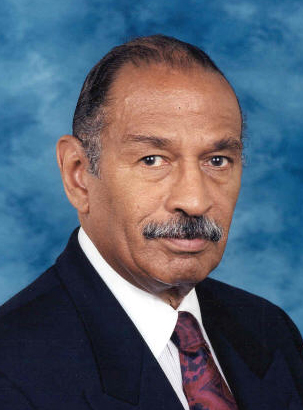 But that stance may have changed, at least with
regard to Rep. Conyers (at left). Yesterday,
the Congressman published a letter in Roll
Call, "The Newspaper of Capitol Hill," that suggested Mr. Conyers
may have had a change of heart ("Conyers: Patent System Needs Updating"). While short on specifics, the letter was full of the usual patent reform
platitudes that well up whenever Members of Congress discuss the issue. "American technological leadership
. . . probably would not have emerged without patent protection" according
to the Congressman (ominously) at least in the telecommunications industry
(which has been a major supporter, financial and otherwise, of Senator Leahy's "reform"
efforts). The U.S. Congress "has
been a world leader in responsible
intellectual property policies" (emphasis added) particularly with regard
to Mr. Conyers leadership by his "championing" of the Prioritizing
Resources and Organization for Intellectual Property Act (which was related to
stronger antipiracy provisions in copyright and trademark). He repeats the argument that Congress "has
not substantively altered patent law for more than 50 years," ignoring the
Hatch-Waxman Act (1984), the American Inventor Protection Act (1999), and the
sweeping changes resulting from adoption of the provisions of the Uruguay Round
of the General Agreement on Tarriffs and Trade (GATT) that changed U.S. patent
term, among others. He references
a hearing before his committee on May 5th where he and his colleagues heard testimony that the Office "does
not have the resources it needs to speedily process meritorious patent
applications and [uh, oh] to effectively filter out bad patent claims."
He makes the reasonable assertion that the lack of
timeliness in examining patents has a "direct impact" on American
competitiveness, citing the backlog and the long pendency times. He says that "[w]hen applications do not get
examined in a timely fashion, important innovations are delayed or lost to the
public" and that "the delay is effectively an opportunity cost levied
onto the applicant, in addition to the fees that must be paid for the
examination service, and it does a disservice to the public that stands to
benefit." He outlines the
Office's plan to address these issues, including increased (or at least status quo) staffing levels, and improvements
in the IT infrastructure and in how Examiner's work is assessed. He also mentions (correctly) that the
Office needs funding to achieve these goals (something that the Senate bill
does not address). "The time
is ripe for fixing a system everyone agrees is failing."
Showing
that his understanding of the problem is up-to-date, the Congressman cites the
Supreme Court's decision in Bilski v.
Kappos as evidence that U.S. patent law is governed by a "relatively
antiquated statute" that even the High Court has trouble interpreting
(ignoring how much of this difficulty is of the Court's own making and has
persisted through several iterations of the U.S. patent statute hying back to
the 19th Century). The Congressman chooses selective quotations from the decision to
suggest that the Court was inviting Congress to solve these dilemmas. He does (presciently, albeit perhaps
inadvertently) caution that the alternative to robust patent protection is
trade secret, which is "a poor outcome because trade secrets do not enrich
the public knowledge and do not foster subsequent innovation."
The discouraging portion of the letter is its last paragraph,
insofar as it heralds an inclination to acquiesce to Senator Leahy's 11th
hour attempt to impose S. 515 on a reluctant populace:
Over several Congresses, I have worked
well with my good friends on both sides of the aisle, in both the House and Senate,
for substantive reform of the patent laws. I will continue those efforts to
achieve the intellectual property system necessary to protect American growth
and innovation in our increasingly global economy.
It may be time once again for the patent community
to contact their Representatives and Senators and explain (once again) why
S. 515 is not patent reform and should be defeated.
Patent Docs thanks Stan Delo for letting us know about Senator Leahy's intended maneuver.


 Patent Docs
Leave a comment