
By
James DeGiulio —
 After
After
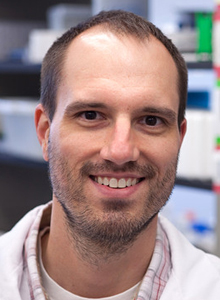
a 15-year effort, the team of Daniel Gibson (at right), Hamilton Smith, and Craig
Venter (below left) have created the first cell controlled by a purely synthetic
genome. In a press release
and accompanying press conference, Dr. Venter described the converted cell as "the
first self-replicating species we've had on the planet whose parent is a
computer."
 As
As
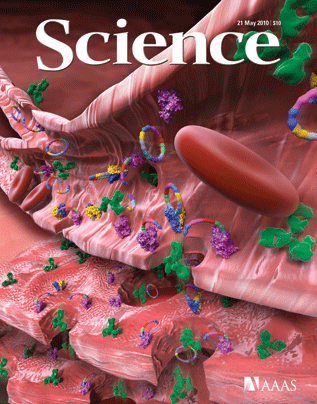
reported in the May 20 issue of Science, in an article entitled "Creation of a Bacterial Cell Controlled by a Chemically Synthesized
Genome," the research team at the J. Craig Venter Institute
in Rockville, Maryland designed 1,078 specific cassettes of DNA that were 1,080
base pairs long and ordered them from DNA synthesis company Blue Heron
Biotechnology. To ensure that the assembled genome would be recognizable as
synthetic, four of the ordered DNA sequences contained strings of bases that,
in code, spell out an e-mail address, the names of the people involved in the
project, and a few famous quotations from James Joyce and other authors. The
team then assembled the shorter lengths into a complete Mycoplasma mycoides genome. The researchers transferred the synthetic genome into a recipient cell
from a different bacterial species, replacing the endogenous DNA, and the cell
became entirely controlled by the new synthetic genome. The cell was
essentially converted into a different species, for the finished product was
capable of replication and had all the expected properties of a Mycoplasma mycoides bacterium.
 The
The
cost of the project was $40 million, most of it paid for by Synthetic Genomics,
a company Dr. Venter founded. Not surprisingly, Venter has applied for several
patents covering the work, assigning them to his company. Synthetic Genomics has a contract from
Exxon to generate biofuels from algae. However, the bacterium used by the
Venter group is unsuitable for biofuel production, and Dr. Venter said the team
would move on to more suitable organisms. Dr. Venter and his colleagues hope to
design new bacteria that will perform useful functions, such as production of
new fuel molecules, new food oils, and new biologically derived sources of
plastic and chemicals. Dr. Venter
predicted that the first application the world may see could be as soon as next
year.
Dr.
Venter's "synthetic cell" has the potential to rejuvenate nagging
questions of ethics, law, and public safety about artificial life that
bio-ethicists have been debating for more than a decade. However, some
scientists downplayed the development, finding it as merely a technical
accomplishment, since the new cell can be viewed as an organism with a
synthetic genome, not as a synthetic organism.
President
Obama has asked the White House bioethics commission to report back to him on
the significance of this development, and
Nature has published a series of opinions on Dr. Venter's article from
synthetic biology experts. Patent Docs
will address the commentary and additional reactions to Dr. Venter's discovery
in future posts.
For additional information regarding this and other related topics, please see:
• "Playing the Bioterror Card in the Synthetic Biology Debate," December 19, 2007
• "The Synthetic Biology Sky Is Not Falling," December 16, 2007
• "Patenting
Life (Really)," June 11, 2007
James
DeGiulio has a doctorate in molecular biology and genetics from
Northwestern University and is a third-year law
student at the Northwestern University School of Law. Dr. DeGiulio
was a member of MBHB's 2009 class of summer associates, and he can be
contacted at degiulio@mbhb.com.


 Patent Docs
Leave a comment