
By Andrew Williams —
 Last week, in Scantibodies
Laboratory, Inc. v. Immutopics, Inc., the Federal Circuit affirmed a claim
construction decision and corresponding summary judgment of non-infringement
rendered by the U.S. District Court for the Central District of California. The patent at issue was U.S. Patent No.
6,689,566 ("the '566 patent"), "Methods, Kits, and Antibodies for Detecting
Parathyroid Hormone." Claim 5, the
only claim addressed on appeal, reads (with the claim terms at issue
underlined):
5.
A method for measuring an amount of whole parathyroid hormone in a
sample comprising:a) adding to a sample a labeled antibody or
antibody fragment specific for an initial peptide sequence of whole
parathyroid hormone wherein said initial peptide sequence consists of VAL-SER-GLU-ILE-GLN-LEU-MET
(SEQ ID NO:3), and wherein at least four amino acids in said initial peptide
sequence are part of a reactive portion to said labeled antibody;b) allowing said labeled antibody to bind to whole
parathyroid hormone present, thereby forming a complex; andc) measuring the amount of said labeled complex to
measure the amount of whole parathyroid hormone in said sample while not
detecting an interfering non-(1-84) parathyroid hormone fragment.
The District Court construed these terms to mean:
• "specific for" = having a measurable affinity for
and detectable binding to an epitope having at least four amine acids of the
seven in SEQ ID No. 3 (VAL-SER-GLU-ILE-GLN-LEU-MET)
• "not detecting an
interfering non-(1-84) parathyroid hormone fragment" = having no detectable
binding to an interfering non-(1-84) parathyroid hormone fragment
Because Scantibodies conceded that the accused
Immutopics antibody did not meet the later limitation, the District Court
granted summary judgment of non-infringement.
 The application that issued as the '566 patent was
filed January 14, 1999. The
application described antibodies, methods of use, and kits for detecting whole
or non-fragmented parathyroid hormone ("w-PTH") in a biological
sample. Measuring serum levels of
PTH in patients is important for a large number of diseases, including familial
hypocalciuric, osteoporosis, and Paget's bone disease. However, measuring biologically active
levels of PTH in humans has been challenging. One problem is that PTH circulates at extremely low
levels. In addition, these
circulating levels of protein are heterogeneous due to the large number of PTH
fragments, which leads to interference when attempting to measure the
biologically active form ("the (1-84) PTH fragment"). In order to overcome this fragment
interference, two-site immunoradiometric assays had previously been developed,
which allow for the measurement of intact PTH ("I-PTH"). A measurement of I-PTH, however,
includes w-PTH and a large PTH fragment cleaved at amino acids 5 to 8. In fact, patients with hyperparathyroid
or renal failure have significant concentrations of these large, non-whole PTH
fragments, which can give inaccurate measurements of the biologically active
form. To overcome this problem,
the Scantibodies scientists discovered methods for detecting w-PTH in a
biological sample while not detecting this non-(1-84) large PTH fragment
component of I-PTH. They also
developed antibodies for use with such methods. The Scantibodies method used an antibody "specific for"
at least four amino acids of seven amino acids disclosed from the N-terminal
end of the protein. Use of such an
antibody was important, because it would not react with the interfering
non-(1-84) parathyroid hormone fragment.
The originally filed claims in the application that
lead to the '566 patent did not contain the limitation "not detecting an
interfering non-(1-84) parathyroid hormone," even though the necessity of
not detecting this fragment was described in the specification. During prosecution, however, the
examiner cited to several pieces of art in both novelty (§ 102) and obviousness
(§ 103) rejections. The most
significant art described the methodology of the measurement of I-PTH. In order to obtain allowable claims,
therefore, the applicant amended the claims to include the "not detecting"
limitation, because apparently all of the prior art methods couldn't
differentiate w-PTH from this interfering non-(1-84) parathyroid hormone.
 Scantibodies filed the present lawsuit on October
26, 2004. Subsequently, both
parties filed reexamination requests, which eventually resulted in a
reexamination certificate that altered the antibody and kit claims, but apparently
did not change the method of use claims. This may be the reason that the parties focused on claim 5 during the
appeal. The District Court
determined that it needed to construe the claims before it could issue a
non-infringement summary judgment order. And, after two claim construction orders, the Court did just that. Scantibodies appealed.
 The Federal Circuit recognized that the District Court's construction of "not detecting" to mean "no detectable
binding" created a difficult, although not insurmountable, hurdle for
finding infringement. Apparently,
Scantibodies argued that such a definition would exclude all antibodies,
because it was impossible not to have some cross-reactivity. However, the specification of the '566
patent apparently touted the fact that no cross-reactivity could be
achieved. Moreover, the Federal
Circuit pointed out that this construction was based on another limitation that
Scantibodies did not challenge ("does not specifically bind to an interfering non-(1-84) parathyroid hormone fragment"). The Court did not give much weight to the
testimony of one of the patentees, nor did the Court find it relevant that
Scantibodies' product literature defined "no cross-reactivity" as "no
significant cross-reactivity." Scantibodies argued that no PTH assay can absolutely detect PTH without
detectable cross-reactivity. However, the Court pointed out a 2001 reference from Gao et al., which
included the inventors as authors, disclosing that an N-terminal PTH antibody that
bound to the first few amino acids, and did not have detect the (7-84) PTH
fragment at concentrations of 10,000 pg/ml. The Federal Circuit used this as proof that it was possible
to meet the limitations of the claim as construed by the District Court.
Finally, the Federal
Circuit noted that the error should be assigned to the patent drafters, because
if they had wanted "not detecting" to mean something else, they could
have either used different claim language, or provided a different definition
in the specification. This
analysis ignores the reality that this claim limitation was required to
overcome prior art cited during prosecution. Moreover, it ignores the fact that the specification
highlighted the criticality of not detecting an interfering non-(1-84)
parathyroid hormone fragment. In
fact, it is possible that if the claims had issued without the "not
detecting" limitation, Scantibodies could have had a written description
problem. Therefore, the Federal
Circuit is correct in pointing out that claim drafters need to be careful in
choosing the language of claim limitations, but claim drafters also
need to mindful of the invention that is actually disclosed in the
specification.
Scantibodies Laboratory, Inc. v. Immutopics, Inc. (Fed. Cir. 2010)
Nonprecedential disposition
Panel: Chief Judge Michel and Circuit Judges Plager and Moore
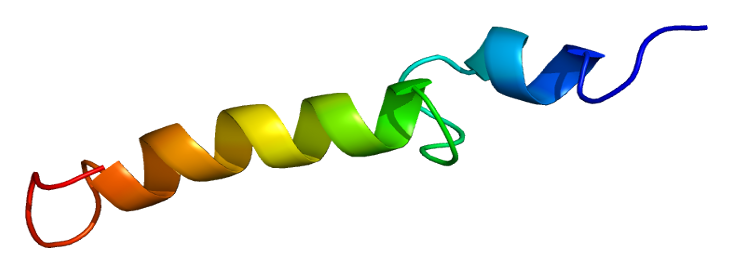
Opinion by Chief Judge MichelImage of parathyroid hormone (above) by Emw, from the Wikipedia
Commons under the Creative Commons
license.


 Patent Docs

Leave a comment