
By
James DeGiulio —
 On
On
April 13, 2010, Sloning Biotechnology announced the
issuance of U.S. Patent No. 7,695,906, which covers an optimized method of
Slonomics, the company's platform technology. Slonomics uses a set of double
stranded DNA triplets as universal building blocks for the synthesis of
combinatorial libraries. This triplet library contains all possible sequence
combinations necessary to build any desired DNA molecule.
In
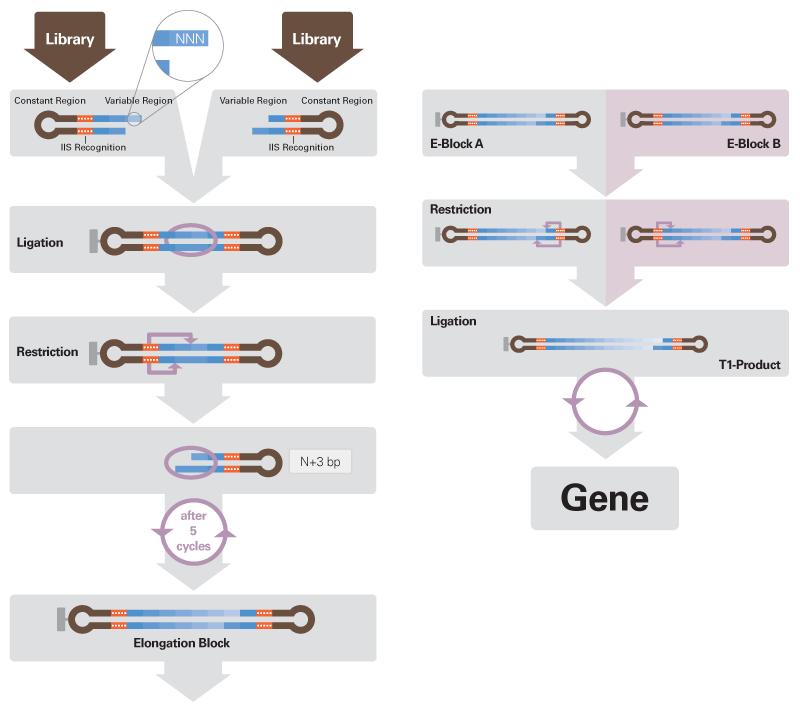
the first phase of Slonomics (see below; click on image to enlarge), the triplet building blocks are sequentially
ligated in a series of cycles referred to as elongation. The output of this
elongation phase is a large number of sub-fragments of the target sequence
referred to as E-blocks, which together comprise the complete target sequence. These E-blocks are then assembled in a second synthesis phase, referred to as
transposition, to generate the desired DNA. Adjoining E-blocks are ligated
together to create T-blocks, which are then sequentially ligated to generate
larger fragments. This process is repeated until all the blocks are combined
into a single DNA molecule comprising the complete sequence.
Although
this method is suitable to automation, the standard Slonomics method produces
an unacceptable number of side products. These incomplete side products can
ligate in the subsequent transposition reactions and lead to the formation of
incomplete T-blocks, thus reducing the yield of the correct product.
The
'906 patent describes the particular reaction steps in the elongation process
that results in a reduction of undesired by-products, thus increasing the
efficacy of the desired nucleic acid molecule. The patent provides three examples of this optimized process
and contains 16 total claims. The
independent claims read as follows:
1. A method for the manufacture of a
nucleic acid molecule comprising the steps of:
(a)
providing a first at least partially double-stranded oligonucleotide which has
a modification allowing the oligonucleotide to be coupled to a surface, whereby
the oligonucleotide comprises a recognition site for a first type IIS
restriction enzyme which cuts outside its recognition site, and which
oligonucleotide comprises a single-stranded overhang;
(b)
providing a second at least partially double-stranded oligonucleotide whereby
the oligonucleotide comprises a recognition site or a part thereof or a sequence
which is complementary thereto, for a second type IIS restriction enzyme which
cuts outside its recognition site, and which second oligonucleotide comprises a
single-stranded overhang;
(c)
ligating the first and the second oligonucleotide via their overhangs
generating a first ligation product, wherein the first and second
oligonucleotides are not attached to a surface during the ligation;
(d)
immobilising the first ligation product of step (c) to the surface via the
modification;
(e)
cutting the immobilised ligation product with the first type IIS restriction
enzyme thus releasing an elongated oligonucleotide having an overhang;
(f)
combining the elongated oligonucleotide with a further at least partially
double-stranded oligonucleotide which has a modification allowing the oligonucleotide
to be coupled, to a surface, whereby the further oligonucleotide comprises a
recognition site for a further type IIS restriction enzyme which cuts outside
its recognition site and which oligonucleotide comprises a single-stranded
overhang, and ligating the elongated second oligonucleotide and the further at
least partially double-stranded oligonucleotide via their overhangs forming a
further ligation product;
(g)
immobilising the further ligation product to a surface via the modification;
(h)
cutting the further ligation product with the further type IIS restriction
enzyme releasing an elongated oligonucleotide having an overhang; and
(i)
optionally, repeating steps f) to h).2. A method for the manufacture of a
nucleic acid molecule comprising the steps of:
(a)
providing a first at least partially double-stranded oligonucleotide which has
a modification allowing the oligonucleotide to be coupled to a surface, whereby
the oligonucleotide comprises a recognition site for a first type IIS restriction
enzyme which cuts outside its recognition site, and which oligonucleotide
comprises a single-stranded overhang;
(b)
providing a second at least partially double-stranded oligonucleotide whereby
the oligonucleotide comprises a recognition site or a part thereof or a
sequence which is complementary thereto, for a second type IIS restriction
enzyme which cuts outside its recognition site, and which second
oligonucleotide comprises a single-stranded overhang;
(c)
ligating the first and the second oligonucleotide via their overhangs
generating a first ligation product, wherein the first and second
oligonucleotides are not attached to a surface during the ligation;
(d)
cutting the ligation product with the first type IIS restriction enzyme thus
generating an elongated oligonucleotide having an overhang and a shortened
first oligonucleotide;
(e)
immobilising the shortened first oligonucleotide on a surface via the
modification;
(f)
providing a further at least partially double-stranded oligonucleotide which
has a modification allowing the further oligonucleotide to be coupled to a
surface, whereby the further oligonucleotide comprises a recognition site for a
further type IIS restriction enzyme which cuts outside its recognition site and
which oligonucleotide comprises a single-stranded overhang;
(g)
combining the elongated oligonucleotide with the further oligonucleotide and
ligating the elongated oligonucleotide and the further oligonucleotide via
their overhangs forming a further ligation product;
(h)
cutting the further ligation product with the further type IIS restriction
enzyme generating an elongated oligonucleotide having an overhang and a
shortened further oligonucleotide; and
(i)
optionally, repeating steps e) to h).7. A method for the manufacture of a
nucleic acid molecule comprising the steps of:
(a)
providing a first at least partially double-stranded oligonucleotide which has
a modification allowing the oligonucleotide to be coupled to a surface, whereby
the oligonucleotide comprises a recognition site for a first type IIS
restriction enzyme which cuts outside its recognition site, and which
oligonucleotide comprises a single-stranded overhang, and whereby the
oligonucleotide comprises a part of the nucleic acid molecule to be
manufactured;
(b)
immobilizing the first oligonucleotide on a surface;
(c)
cutting the first oligonucleotide with the first type IIS restriction enzyme
releasing a double stranded oligonucleotide having a single stranded overhang at
each end and being a part of the nucleic acid molecule to be manufactured; and
(d)
combining the double stranded oligonucleotide of step c) with a second at least
partially double-stranded oligonucleotide which has a modification allowing the
oligonucleotide to be coupled to a surface, whereby the oligonucleotide
contains a recognition site for a second type IIS restriction enzyme which cuts
outside its recognition site, and which oligonucleotide further comprises a
single-stranded overhang and a part of the nucleic acid molecule to be
manufactured, and ligating the double-stranded oligonucleotide of step c) with
the second oligonucleotide, wherein the double-stranded oligonucleotide of step
c) and the second oligonucleotide are not attached to a surface during the
ligation; whereby the overhang of the second oligonucleotide is essentially
complementary to the overhang of the double stranded oligonucleotide of step
c).9. A method for the manufacture of a
nucleic acid molecule comprising the following steps:
(a)
providing a first ligation product, whereby the first ligation product consists
of a first oligonucleotide moiety comprising a recognition site for a first
type IIS restriction enzyme, a second oligonucleotide moiety comprising a
recognition site for a second type IIS restriction enzyme and a third
oligonucleotide moiety, whereby the third oligonucleotide moiety is a part of
the nucleic acid molecule to be manufactured, and whereby the first and the
second type IIS restriction enzymes each generate an overhang, whereby the
overhang generated by the first type IIS restriction enzyme has a length which
is different from the length of the overhang generated by the second type IIS
restriction enzyme;
(b)
providing a second ligation product, whereby the second ligation product
consists of a first oligonucleotide moiety comprising a recognition site for a
third type IIS restriction enzyme, a second oligonucleotide moiety comprising a
recognition site for a fourth type IIS restriction enzyme and a third oligonucleotide
moiety, whereby the third oligonucleotide moiety is a part of the nucleic acid
molecule to be manufactured, and whereby the third and the fourth type IIS
restriction enzyme each generate an overhang, whereby the overhang generated by
the third type IIS restriction enzyme has a length which is different from the
length of the overhang generated by the fourth type IIS restriction enzyme;
(c)
cutting the first ligation product with the second restriction enzyme
generating a first cut ligation product and cutting the second ligation product
with the fourth restriction enzyme generating a second cut ligation product;
(d)
providing a third at least partially double-stranded oligonucleotide and
ligating the third oligonucleotide with the first cut ligation product, wherein
the first cut ligation product and the third oligonucleotide are not attached
to a surface during the ligation, whereby the third oligonucleotide comprises
an overhang which is complementary to the overhang of the first cut ligation
product generated in step c) and whereby the third oligonucleotide comprises a
recognition site for a fifth IIS restriction enzyme;
(e)
providing a fourth at least partially double-stranded oligonucleotide and
ligating the fourth oligonucleotide to the second cut ligation product, wherein
the second cut ligation product and the fourth oligonucleotide are not attached
to a surface during the ligation, whereby the fourth oligonucleotide comprises
an overhang which is complementary to the overhang of the second ligation
product generated in step c) and whereby the fourth oligonucleotide comprises a
recognition site for a sixth type IIS restriction enzyme;
(f)
immobilising the ligation product of step d) and step e) on a surface by means
of a modification of the third oligonucleotide and the fourth oligonucleotide;
(g)
cutting the immobilised ligation product of step d) with the fifth type IIS
restriction enzyme releasing an oligonucleotide;
(h)
cutting the immobilised ligation product of step e) with the third type IIS
restriction enzyme; and
(i)
combining and ligating the oligonucleotide released according to step g) with
the immobilised reaction product of step h), whereby the overhang generated by
the first and the third restriction enzyme is complementary to the overhang
generated by the fifth and sixth restriction enzyme.
James
DeGiulio has a doctorate in molecular biology and genetics from
Northwestern University and is a third-year law
student at the Northwestern University School of Law. Dr. DeGiulio
was a member of MBHB's 2009 class of summer associates, and he can be
contacted at degiulio@mbhb.com.
 Patent Docs
Leave a comment