
By
Donald Zuhn —
Over
the past twelve months, Patent Docs
has reported on a number of papers, letters, and statements that outline
positions taken by various players in the follow-on biologics data exclusivity
debate. In view of last week's Time magazine article "How
Drug-Industry Lobbyists Got Their Way on Health Care," which mentions that
Duke University Prof. Henry Grabowski's oft-cited data exclusivity study was
funded by the Pharmaceutical Research and Manufacturers of America (PhRMA) and
two partisan patient groups (see
"Time Magazine on Data Exclusivity Debate"),
a review of these players and their positions on the issue seems
appropriate. Yesterday, we
summarized the positions of ten individuals or groups that have participated in
the debate (see "Follow-on
Biologics Data Exclusivity Debate Scorecard – Part I"). Today, we examine the positions of
another seven participants in the debate.
Among those who have advocated for shorter data exclusivity periods (i.e., less than 8 years) are:
 •
•
The AARP, which sent a letter to members of Congress stating that "there
is little to support" the argument that legislation providing up to 5.5
years of data exclusivity "would undermine [the biotech/pharma industry's]
ability to recoup the costs of drug development" (see "BIO CEO Provides Update on Follow-on Biologics
Legislation"). In addition, the organization's letter
asserted that "based on U.S. drug sales alone, many top selling biologics
have recouped their manufacturer’s initial investment several times over in the
last six years — often within a single year."
 •
•
The Federal Trade Commission (FTC), which issued a report on follow-on
biologics stating that a 12-14 year data exclusivity period was not necessary
to promote innovation by pioneer biologics companies (see "No One
Seems Happy with Follow-on Biologics According to the FTC"). The FTC report opines that data
exclusivity would be in addition to the incentives provided by patent
protection and market-based pricing, and thus data exclusivity would provide no
additional incentives to developing biologics drugs.
 •
•
The Office of Management and Budget (OMB), which sent a letter to Rep. Henry
Waxman (D-CA), the Chairman of the House Energy and Commerce Committee, stating
that a follow-on biologics regulatory pathway providing a 7-year data
exclusivity period would "strike[] the appropriate balance between
innovation and competition" (see
"White House Recommends 7-Year Data Exclusivity Period for Follow-on
Biologics"). The OMB letter was was signed by Peter
Orszag, Director of the OMB, and Nancy-Ann DeParle, director of the Office of
Health Reform.
Among
those who have advocated for longer data exclusivity periods (i.e., 10 or more years) are:
 •
•
Dr. John Calfee (at right) of the American Enterprise Institute for Public Policy
Research (AEI), who wrote a white paper indicating that longer data exclusivity
periods would provide the more prudent approach to the regulation of follow-on
biologics (see "AEI Believes
Advantages of Longer Data Exclusivity Period Outweigh Disadvantages"). In his paper, Mr. Calfee stated that "[g]iven
the stakes — a substantial amount of future R&D hangs in the balance —
Congress should exercise an abundance of caution in designing follow-on
biologic legislation so as not to endanger valuable future research," and
concluded that "the social losses from providing for fairly long exclusivity
periods (twelve to fourteen years) would be small compared to what are likely
to be substantial social gains from exclusivity."
 •
•
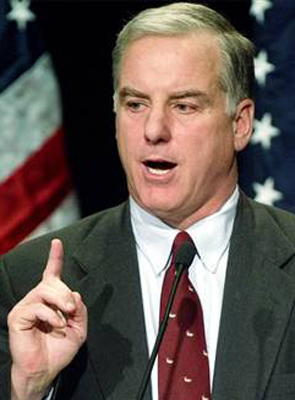
Democratic National Committee chairman Dr. Howard Dean (at right), who wrote an Op-Ed
piece in The Hill backing legislation
that would provide up to 14.5 years of data exclusivity (see "BIO CEO Provides Update on Follow-on Biologics
Legislation"). Dr. Dean argued that:
A
commonsense and fair approach, similar to the process and timeline currently in
place for generic versions of chemical-based medicines, would allow the
original developer of the biologic to protect the proprietary data used to
develop the medicine for at least 12 years. A shorter exclusivity period would prematurely rob biotech
innovators of their intellectual property and destroy incentives to develop new
cures. Most firms would be unable
to recoup their investments in new medicines, which ordinarily top $1 billion and
involve 15 years of research and development. If we discourage investment, we jeopardize the development
of the next generation of breakthrough medicines and cures.
•
The
Pharmaceutical Research and Manufacturers of America (PhRMA), which issued a
statement warning that "[g]iving short shrift to incentives for innovation
would grind to a halt uniquely American innovation, moving critically important
R&D — and tens of thousands of U.S jobs – overseas," and stating that
"[e]conomists and the venture capitalists whose private investments shore
up this vital, yet vulnerable sector agree: 12 years of data protection, at a bare minimum, are needed
to help recoup the significant development costs for biologic innovators"
(see "PhRMA Supports Follow-on
Biologics Regulatory Pathway Providing 12-Years of Data Exclusivity"). The advocacy group representing
pharmaceutical and biotechnology research companies noted that
"[c]ompanies could still seek approval of competing biologics using their
own data, but for those 12 years no biosimilar competitor could rely on
innovators’ hard–earned data, collected during development that may span a
decade, or more, to seek approval."
 •
•
Senators Orrin Hatch (R-UT), Barbara Mikulski (D-MD), Michael Enzi (R-WY), and
Kay Hagan (D-NC), who wrote a letter to Senate majority leader Harry Reid
(D-NV) noting that "[m]ore than 150 patient groups, research universities,
local chambers of commerce, venture capital groups, and innovators have
expressed strongly that a base 12 years of data exclusivity is crucial to
ensure continued growth in the biotechnology industry and future discoveries
that will make a difference in the lives of millions of patients," and urging
the majority leader "to support the enactment of a pathway for the
approval of biosimilars with a base 12·year period of data exclusivity for
innovator biotechnology companies" (see
"Four Senators Write in Support of 12-Year Data Exclusivity Period").
Readers
are encouraged to review our prior coverage of the papers and letters described
above.
 Patent Docs
Leave a comment