
By Kevin E. Noonan —
 The Biotechnology Industry Organization (BIO) held
a media briefing on Federal policy issues today, with most of BIO's executive
staff assembling at BIO headquarters in Washington, D.C. In addition to the media present on
site, BIO hosted several more members of the press by teleconference.
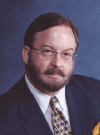
 Jim Greenwood (at left), BIO's President and CEO, started the
meeting with prepared remarks concerning healthcare reform, patent reform, and
the energy bill. With regard to
healthcare reform, Mr. Greenwood reiterated BIO's support, provided that any
healthcare bill recognize four fundamental objectives: access for all ("every man, woman
and child"), cost containment, quality, and innovation. Mr. Greenwood also mentioned
biosimilars legislation, where he expressed pride that BIO had "played it
straight" with legislators "from the beginning." BIO's position was consistently that a
14-year data exclusivity period was the right length, and didn't advocate for
longer terms of 16-18 years as a negotiating ploy. He said that BIO had done "quite well" against a "well-organized
coalition" of generics companies, the AARP, the White House, and other
factions. He also said that BIO
was willing to accept the Senate bill's compromise of 12 years if that was what
it takes to get a bill passed. He
also voiced BIO's support for "comparative effectiveness" as a tool
for making medical decisions but not for reimbursement. On energy, Mr. Greenwood maintained
that there was no way to significantly reduce greenhouse gases without
contributions from biotechnology, including cellulosic ethanol technology,
algae, and other methods of energy production. Mr. Greenwood ended his remarks with patent reform, which he
characterized as a "long, hard fight" contested "at a great
disadvantage" against an IT industry that supported "reforms"
that would make it "easier to infringe patents." He voiced BIO's support for the
compromise that had produced a bill in the Senate.
 Also addressing the press was Dr. Stephen Sherwin (at right),
BIO's chairman and also the Chairman of Cell Genesys, Inc. Dr. Sherwin, a biotech entrepreneur
throughout his career, spoke on the economic climate for biotechnology. He mentioned the obvious — that it had been an "extremely
difficult and challenging time" for biotech over the past 18-24 months,
with almost half of the organization's member companies having enough cash for
12 months and a quarter having less than 6 months of cash reserves. He also mentioned that there has been
no significant IPO activity in the biotech sector in almost two years. The reason is that investors are
nervous about the regulatory environment if there is a follow-on biologics bill
and the effects any FOB bill may have on the timing of product
development. (In response to a
question, Dr. Sherwin said that Wall Street hates uncertainty, even when it is
uncertainty Wall Street has created.) On the bright side, Dr. Sherwin mentioned that there had been "some
thawing" in the capital markets in the face of "good news" from
clinical trials, etc. He also noted
that he had met with the new FDA commissioner, Dr. Hamberg, and was pleased with
her "science-based" approach. He also noted that there was progress on reauthorizing SBIR
grant legislation that would permit companies having venture capital funding to
compete for such grants. He said
that he was optimistic, but that "we have our work cut out for us."
In the question-and-answer portion of the meeting,
Mr. Greenwood responded to a question from Reuters on healthcare reform that
certain revenues for smaller companies — like royalties and milestone payments —
should be exempt from the fees (or taxes) that the Obama administration
proposed on drug sales revenues in an agreement with the pharma industry
announced earlier this summer. Mr.
Greenwood also reminded listeners that predictions such as a recent one by
BioWorld, that biotech drugs would represent 50% of all new drugs by 2015 and
71% by 2025, might not come to pass if a shortened data exclusivity period
drove investment away from the biotech sector. The 12-year period is the minimum required to maintain
the incentives for investment in new biologic drugs, which is why BIO supports
this number. Investors have other
opportunities that are less risky that they will take if there isn't a
sufficient data exclusivity period to support such investment, Mr. Greenwood
said.
 Business Week asked about BIO's position on the "politics"
of 'partisan gridlock" over the healthcare and energy bills, where
Republicans might oppose the bills merely to hand the Obama administration a
political defeat. Mr. Greenwood
said it wasn't BIO's role to try to "change the playbook" for the
parties, and that the "big picture" required healthcare reform. BIO has been (and by implication, will
continue to be) "religiously non-partisan" on the healthcare issue,
resulting in strong bipartisan support (with 28 of 38 Democratic members and all but one Republican member of the Energy and
Commerce committee voting for the biosimilars amendment supported by BIO). There is nothing partisan about using biotechnology in
reducing greenhouse gases, he said. Brent Erickson (at left), BIO's Executive Vice President, Industrial and
Environmental Section, chimed in that opposition to the energy bill was not
partisan so much as regional, reflecting differences in the reliance of
different sections of the country on fossil fuels. It has been "a bit of an uphill battle" in
educating Congress about the contributions of biotechnology in addressing
climate and energy problems, he said.
 Mr. Greenwood had another opportunity to remind his
listeners that BIO had played the role of honest broker in the healthcare
debate, in response to a question from the Pink Sheet about whether BIO would
need to "cut a deal" with the Obama administration like PhRMA did
(according to the Pink Sheet reporter). Mr. Greenwood said there had not been any horse-trading or quid pro quo
in BIO's position — he said that BIO's success in pursuing its agenda regarding
FOB legislation was the result of old-fashioned "shoe leather"
politics, by meeting with "scores" of Congressional leaders and
explaining BIO's position. He
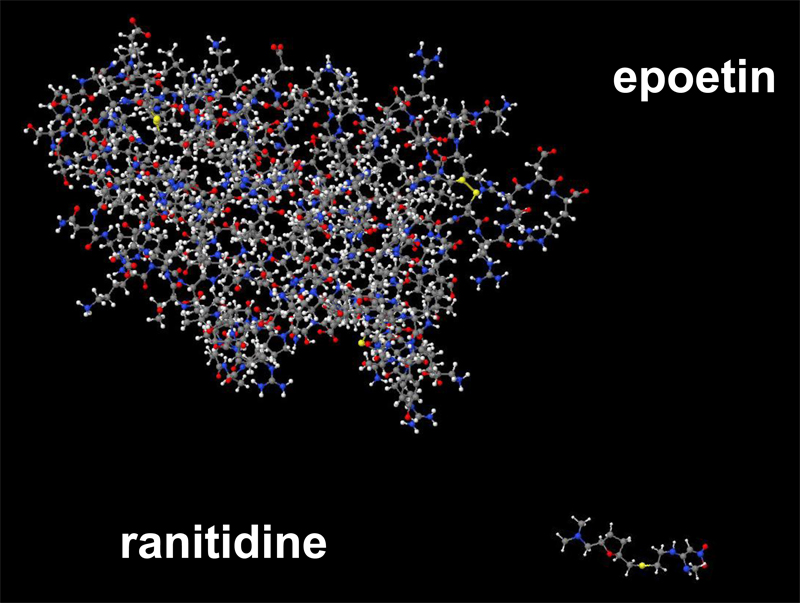
mentioned that he carried two things to these meetings: a model of the aspirin molecule and a
DVD showing the structure of erythropoietin (see image at right). Mr. Greenwood also said that BIO's
success makes getting a bill passed even more important, since BIO's "enthusiasm
for the package [will be] dramatically diminished" if the bill undergoes
major changes in the House.
Dr. Sherwin addressed a question about the
priorities BIO would advocate for the FDA. He mentioned that he was "encouraged' by the new FDA
commissioner's (science-driven) approach, which he says he expects to be
characterized by "efficiency" and "clarity." He said there will be an effort to
strike a balance between safety and efficacy, a balance he said was familiar to
all physicians in assessing risks and benefits of any course of treatment. While acknowledging that a single
meeting could not address complex issues, he said he was "encouraged"
by having someone with her background in her position early in the Obama
administration.
Andrew Noyes from Congress Daily asked about patent
reform, and Brent Delmonte, BIO's Vice President for Governmental Relations
said that BIO hopes for support for the Senate bill, a "fair, responsible
compromise," and that contentious bills (like H.R. 1908 from the
previous Congress) could slow patent reform. He mentioned "great ideas" from both sides of the
Hill, including re-examination and the "second window," and the "gatekeeper"
function of judges on the damages issue. On balance, BIO remains "hopeful" for a patent reform bill in
this Congress, but doesn't see any "date certain" for the bill coming
to the floor.
A reporter from Scripps News asked the panel about
the SBIR bill, and Mr. Greenwood said that BIO was very pleased with the result
of the vote on the reauthorization bill in the House, which passed the bill
386-41. Alan Eisenberg, BIO's
Executive Vice President Emerging Companies and Business Development, mentioned
that the SBIR program is funded by a 2.5% set-aside from other departments and
Federal agencies (the Department of Defense, the Department of Energy, the
National Institutes of Health), and that the bill was an attempt to overturn "fairly
arbitrary" administrative agency (Small Business Administration) decisions
that prevented venture capital-funded companies — the majority of BIO's small
company members — from participating. BIO is confident that Congress will be able to resolve differences between
the House and Senate versions of the bill.
Hans Sauer, BIO's Associate General Counsel for
Intellectual Property, fielded a question on the Bilski case, specifically why BIO was interested in the case. Mr. Sauer provided a brief synopsis of
the case, mentioning that the Federal Circuit had fashioned a rule on patent
eligibility of method claims that was far broader than necessary to answer the
question of whether the business method claims in the Bilski patent should be
patent-eligible. This broader rule
put at risk the patentability of claims to important methods, such as
biomarkers and biological correlations with disease, and personalized medicine,
that made the issue one important to BIO. He noted that biotech methods, not business method cases, were some of
the first cases affected by the Federal Circuit's new rule. He expressed confidence that the
Supreme Court would understand these distinctions when it fashions a different
rule in deciding Bilski.
A reporter from the Journal of Commercial Biotechnology
and Scientific American brought the discussion back to the economy, and Mr.
Eisenberg provided some additional sobering statistics. He said that the total number of public
companies has been reduced, some by mergers and acquisitions, and others by
bankruptcy, with more than 20 biotech member companies having declared
bankruptcy under Chapter 11. He
also mentioned that the statistics were more certain for public companies,
which are under an obligation to report bankruptcies, and that privately-held
companies may be able to just "sell their assets" and disappear. The number of public biotech companies
has decreased from 370 to less than 330, and "well over" 100
companies have laid off employees (with a total of 10,000 to 12,000 employees being
laid-off throughout the industry). The most ominous and telling fact, according to Mr. Eisenberg, is that
companies were "shelving" projects having positive clinical data,
simply because the companies don't have the money to continue funding these
projects, and the capital markets have not recovered their interest in the
sector.
Finally, Mr. Greenwood reiterated that BIO is in
favor of healthcare reform, but that it was just as important that any
healthcare reform bill doesn't disincentive innovation. As it is, investors are sufficiently
concerned about FOB legislation that it is an impediment to investment, and it
would help investment, and be favorable to innovation, to get a bill passed and
end the uncertainty that is inhibiting investment in the industry. Mr. Greenwood said that the slogan "heat,
heal and feed the world" reflects BIO's view that you cannot address these
problems in a sustainable way without contributions from biotechnology.
A podcast of the media briefing can be obtained here.

 Patent Docs
Leave a comment