
By Kevin E. Noonan —
 The zeitgeist has turned harshly on patenting in the U.S., perhaps nowhere as starkly as in gene patenting. Originally the subject of op-ed rants by famous authors (see "Science Fiction in The New York Times") and quixotic bills introduced by undistinguished members of Congress (see "The Continuing Threat to Gene Patenting"), the filing by the American Civil Liberties Union of a complaint against Myriad Genetics several weeks ago seems to have opened the floodgates of opposition to these patents. Thus, there have been debates on the topic on National Public Radio (see "Gene Patenting Debate Continues"), and an otherwise respectable blogger has let his pages be used by an academic with more passion than logic to present his anti-gene patenting views.
While there may be a legitimate reason to revisit the question of whether genetic material should be patent-eligible, a great deal of the anti-gene patenting debate is based on faulty premises, incorrect science, and a studied lack of appreciation of patent law as it has been applied, inter alia, to eligibility of natural products. Since any rational debate is only as good as the information it is based upon, in this post we will try to address the more flagrant inaccuracies spouted by the anti-gene patenting crowd.
Genes are a product of nature: The facts. Genes may be, but the patents claiming genes do not claim products of nature. The simple distinction is that gene claims recite that the genes are "isolated," thereby putting to rest the canard (asserted in the pages of the august New York Times by the late Michael Crichton) that a patent holder may one day ring your doorbell and ask for a royalty from you because your liver is "using" a patented gene. More importantly, no one would want to own any person's genes: it has been known for more than forty years that any particular copy of a gene in an individual in a population is likely to contain at least one polymorphism that does or could (under  the right environmental conditions) affect its function. This was illustrated recently in reports of the complete diploid genomic DNA sequence of J. Craig Venter's (at left) DNA, where more than 4 million nucleotide variants were detected (see "A Complete Diploid Human Genome Reveals Some Surprises") — included in those surprises were an extraordinary amount of genetic variation that could affect gene expression and gene products in unpredictable ways.
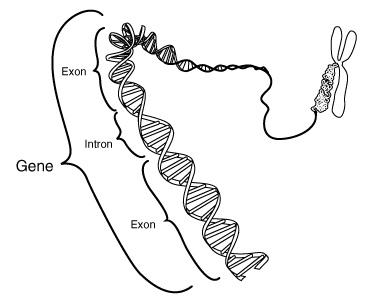
But there is another, more significant distinction that requires a little biology to appreciate. Genes have been described, properly, as the instructions for producing proteins. A gene encodes the amino acid sequence of a protein in a linear sequence of 3-base triplet codons that correspond in linear order to the amino acid sequence of the protein. However, in humans (and all other animals) almost all genes are interrupted by "junk" DNA that does not encode protein (or, at least, the protein the gene encodes). The entire gene, junk and coding sequence, is transcribed into RNA by the cell and then the junk pieces are "spliced out," leaving the coding sequence (termed a messenger RNA or mRNA) that is used to produce the protein. Scientists take advantage of this process to clone genes, by isolating the mRNA and converting it into a DNA molecule called complementary DNA (cDNA) which is what is cloned, sequenced, and patented. The biology is set forth schematically below:
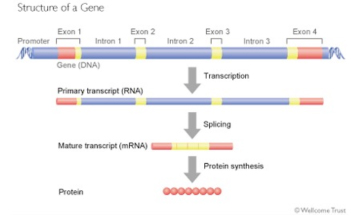
The hallmark of what the Supreme Court has declared is patent-eligible is "anything under the sun made by man." The cDNA copies of genes that form the basis for human gene patenting are "made by man" and not products of nature because they do not exist in nature prior to being synthesized in a test tube by a scientist. If we are honest in defining what are actually "products of nature," then they must by definition be produced by nature. cDNA molecules are not.
Genes are products of nature: The law. The legal argument that "products of nature" such as "genes" are not patent-eligible proves too much, because if genes are not patentable then many other natural products cannot be, either. This includes the example given by Hans Sauer during the NPR broadcast last week, vitamin B12, which was isolated by Merck and patented in the 1930's. It also includes various antibiotics, including lincomycin that was the subject of the In re Bergy case, and any number of products isolated from crude oil, plants, animals, and even humans (see "A DNA Patenting Thought Experiment"). Indeed, there is even a chemical element, Americium, that has been the subject of a patent, because the element is unknown in nature and produced only in a nuclear reactor (and provides one embodiment of smoke detectors found in most homes). If genes are not patent-eligible, based on the fact that they are products of nature, then the patent incentive cannot exist for these "products of nature," either.
Genes are part of "the commons." Ironically, genes and gene patenting were originally assailed as creating a "tragedy of the anticommons," because private "ownership" thereof would impede genetic research. In fact, as has been shown by multiple studies over the past 10 years, gene patenting has done no such thing (see "The True Tragedy of the Anti-Commons"). Indeed, there have been a variety of reports from the U.S. (Walsh et al., 2003, "Science and the Law: Working Through the Patent Problem," Science 299: 1020), Germany (Straus, 2002, Genetic Inventions, Intellectual Property Rights and Licensing Practices), Australia (Nicol et al., 2003, Patents and Medical Biotechnology: An Empirical Analysis of Issues Facing the Australian Industry, Centre for Law & Genetics, Occasional Paper 6) and Japan (Nagaoka, 2006, "An Empirical Analysis of Patenting and Licensing Practice of Research Tools from Three Perspectives," presented in OECD Conference in Research Use of Patented Inventions, Madrid) finding that "patent thickets" (Shapiro, 2001, "Navigating the Patent Thicket: Cross Licenses, Patent Pools, and Standard Setting," In: Innovation Policy and the Economy 1: 119-50) or the "anticommons" (Heller & Eisenberg, 1998, "Can Patents Deter Innovation? The Anticommons in Biomedical Research," Science 280: 698-701) rarely affect the research of academic scientists. In addition, the incentive for gene patenting motivated private companies, most notable Celera and Human Genome Sciences, to compete with the federally-funded efforts to sequence the human genome. This competition accelerated these efforts and produced sequence information more rapidly than anyone expected. If these efforts provided genetic information that can be used to address human disease one day, one month, or one year earlier than it would have been produced otherwise, who can say the incentive is insufficient?
Gene patenting inhibits genetic research. In fact, a very good case can be made that the opposite is true. This is due to another distinction glossed over by the anti-gene patenting crowd: genetic information isn't patented. Patent law requires that claims be supported by a written description sufficient to enable the skilled worker to make and use the invention. For genes, this has meant that the genetic sequence is disclosed in almost all gene patents. This information can be used for any number of purposes, including sequence comparisons (which can be performed without "isolating" a gene), detecting genetic polymorphisms, and a variety of other scientific endeavors. Indeed, agricultural scientists recently reported that they paid no heed to patents encompassing their work and gene patent owners do not enforce their patents against research scientists using gene sequences for basis research. (This statement does not apply to medical scientists and institutions performing fee-for-service testing as in the Myriad case.) For example, a retrospective study of BRCA genes in archival tumor samples (contained as laboratory collections in may hospitals and departments of academic medicine) that demonstrated genetic or familial patterns of BRCA polymorphism inheritance might infringe one of the Myriad patents that are the subject of the ACLU's suit. But it would be surprising if Myriad (or any other gene patent holder) would ever try to assert these patents against this kind of genetic research. We would be interested in any instances where a gene patent owner has threatened enforcement in the absence of commercial activity. Until such time as this evidence is forthcoming (and, to be germane to the debate and support the anti-gene patenting position it would need to be widespread), there is no evidence that gene patenting has a negative effect on genetic research.
We don't need gene patents — researchers will do it anyway. With regard to basic genetic research, this is true — it is the corollary to the previous point, that gene patents don't inhibit genetic research. However, there is a vast gap between identifying a genetic polymorphism related to a disease, or identifying a gene that encodes a useful protein, and developing a clinically-validated test or producing a commercial biologic drug product, and that is where biotechnology companies come in. Of course, without the prospect of patent protection, investors are unlikely to provide the funding needed by start-up biotechnology companies to develop commercial embodiments of these inventions. Large corporations, both foreign and domestic, may be able to do so, but then U.S. universities and research centers become merely unpaid research and development branches of these corporations. And in view of the complexities of biotechnology products, other avenues — trade secrets and regulatory data exclusivity being just two — may enable such companies to keep their "monopoly" much longer than the term of a gene patent. As just one example, the menopause drug Premarin® is not patent-protected but there is no generic version available for just these types of reasons.
Genes are not patentable after In re Kubin. This assertion, made by Joshua Sarnoff, Professor of the Practice of Law at American University's Washington College of Law during the NPR debate, conflates what is patent-eligible with what is patentable, a distinction made nicely by Judge Giles Sutherland Rich in the Bergy case. There are many things that are patent-eligible that are not patentable, because the statutory requirements are different. To be patent-eligible, an invention must be a machine, manufacture, process, or composition of matter, or an improvement thereof, and (per Supreme Court precedent) cannot be a mathematical formula, an abstract idea, or a product of nature. To be patentable, on the other hand, an invention must be new, useful, and non-obvious. The Kubin case merely stands for the court's determination that merely because a gene was unknown in the prior art does not automatically mean that it should be patentable, the principle enunciated by Judge Lourie in In re Deuel based on conventional rubrics of chemical obviousness. But the decision in Kubin was based on a set of facts unlikely to have existed for most genes that have been patented, and its effects have yet to be felt. Despite Professor Sarnoff's statements, genes are not per se unpatentable after Kubin.
Gene patenting inhibits innovation. It is easy to forget today the basis for gene patenting in the past Any number of biologic drugs have been developed that, according to a recent Federal Trade Commission report, "have improved medical treatments, reduced suffering, and saved the lives of many Americans." These drugs were developed by companies that isolated the genes encoding them, including erythropoietin, human growth hormone, interferon, blood clotting Factors VIII and XI, human insulin, tissue plasminogen activator, and a host of others. The patent incentive was instrumental in supporting investment in these companies, and in developing a biotechnology industry in the U.S. that has been a world leader for 25 years. (Paradoxically, this industry arose during a time when the U.S. was popularly portrayed as being a rustbelt has-been, a modern day Great Britain, that would be left in the dustbin of history by emerging economies that were superior to our own.) The U.S. biotechnology industry has resulted in U.S. dominance in the pharmaceutical industry, to the detriment of the very European and Japanese companies poised to overtake this country economically in the past (see "The Continuing Value of Biotech Patenting"). As anyone following the debate on follow-on biologics will recognize, the need for patent protection to attract investment in what remains a fundamentally risky industry has not diminished. Patent policies abroad already permit those countries to "free-ride" on American innovation. Why should we adopt their failed policies here? And who will create the next generation of drugs based on biotechnology if we do?
Why are they lying to us? Michael Crichton did it, Lori Andrews has been known to do it, and Professor Koepsell has done it again — the title of his book against gene patenting is "Who Owns You?" The answer is no one, of course, as explained above, but it does raise a significant question. If the case against gene patenting were so clear, logical, and in the best interests of U.S. innovation, why do its proponents always seem to intimate that somehow someone is trying to own us? It is good propaganda, of course, and it is likely that it will be defended as being merely provocative. But it doesn't advance the debate, it inhibits reasoned discussion, and it suggests (along with the studied ignorance of the facts set forth here and elsewhere) that gene patenting is just wrong somehow. Perhaps it merely vitalism, the quasi-religious notion that natural products isolated from living things are somehow different from what can be found or produced from the inorganic world. This notion was disproven more than 100 years ago by Friedrich Wohler's demonstration that urea (produced in mammalian urine) was in fact merely a chemical compound that could be produced from non-living chemicals in a laboratory.
Or maybe it is just the same contrariness that motivates some to deny evolution or other doctrines that make them uncomfortable. It may be a strain of anti-establishment rebelliousness unique to Americans (and in other contexts, part of what makes America exceptional), or maybe it is merely the window-dressing used to excuse infringement. But unless we all make our arguments based not on fear, ignorance, or dishonesty, there cannot be a real debate. The issue is too important for that.


 Patent Docs
Leave a comment