
District Court Decision Impacts PTA Determinations
By Donald Zuhn —

On September 30th, the District Court for the District of
Columbia granted summary judgment in favor of Wyeth, determining that the U.S.
Patent and Trademark Office had misconstrued 35 U.S.C. § 154(b)(2)(A), and as a
result, had denied Wyeth a portion of patent term to which it was entitled
under U.S. Patent Law (see Memorandum Opinion and Order). The case,
which was decided by Judge James Robertson, should be of interest to patent
practitioners, patentees, and assignees for at least two reasons. First, Judge Robertson's decision
impacts the manner in which Patent Term Adjustment (PTA) is calculated, and
thus, potentially affects the patent terms of numerous patents. Second, Judge Robertson's opinion
includes an interesting analysis of the type of deference the USPTO is owed for
its interpretations of provisions of Title 35.
At issue in Wyeth was the interplay between two of the
patent term guarantee provisions of § 154(b)(1). According to the Court, these provisions provide "a
one-day extension of patent term for every day that issuance of a patent is
delayed by a failure of the PTO to comply with various enumerated statutory
deadlines: fourteen months for a
first office action; four months to respond to a reply; four months to issue a
patent after the fee is paid; and the like" (see § 154(b)(1)(A)) and
"a one-day term extension . . . for every day greater than three years
after the filing date that it takes for the patent to issue, regardless of
whether the delay is the fault of the PTO" (see § 154(b)(1)(B)). The Court labeled the periods of delay
encompassed by § 154(b)(1)(A) as "A delays" or "A periods,"
and the "[t]he period that begins after the three-year window has closed .
. . as the 'B delay' or the 'B period.'" The above delays are subject to the limitations of §
154(b)(2)(A), which states that:
To the extent that periods of delay attributable to
grounds specified in paragraph (1) overlap, the period of any adjustment
granted under this subsection shall not exceed the actual number of days the
issuance of the patent was delayed.
The Court described the above provision as being
"manifestly intended to prevent double-counting of periods of delay,"
explaining that "[p]roper interpretation of this proscription against
windfall extensions requires an assessment of what it means for 'periods of
delay' to 'overlap.'" In a
Federal register Notice entitled "Explanation of 37 CFR 1.703(f) and of
the United States Patent and Trademark Office Interpretation of 35 U.S.C.
154(b)(2)(A)" (69 Fed. Reg. 34238), the Office
states that:
If an application is entitled to an adjustment under 35
U.S.C. 154(b)(1)(B), the entire period during which the application was pending
before the Office (except for periods excluded under 35 U.S.C.
154(b)(1)(B)(i)-(iii)), and not just the period beginning three years after the
actual filing date of the application, is the period of delay under 35 U.S.C.
154(b)(1)(B) in determining whether periods of delay overlap under 35 U.S.C.
154(b)(2)(A).

Summarizing the USPTO's take on § 154(b)(2)(A), the Court
states that "the PTO's view is that any administrative delay under §
154(b)(1)(A) overlaps any 3-year maximum pendency delay under §
154(b)(1)(B): the applicant gets
credit for 'A delay' or for 'B delay,' whichever is larger, but never A +
B." Wyeth, however, argued
that the "A period" and "B period" overlap only if they
occur on the same calendar day or days.
The parties' different perspectives on an exemplary PTA calculation
can be represented schematically as follows (using the example presented in
Judge Robertson's opinion):
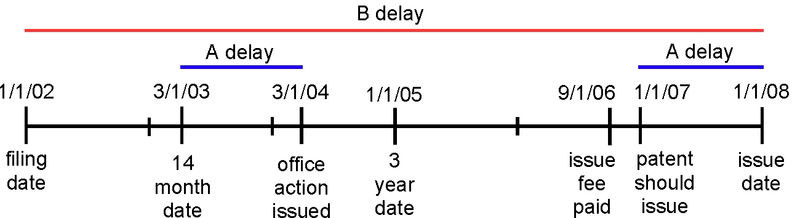
The USPTO's view (shown above): the patentee is entitled to three years of PTA.

Wyeth's view (shown above): the patentee is entitled to four years of PTA.

The Court determined that Wyeth's construction of §
154(b)(2)(B) was correct, stating that "[t]he only way that [A and B]
periods of time can 'overlap' is if they occur on the same day." Thus, in the example shown above,
Wyeth's calculation is the correct one.
According to the Court, "[t]he problem with the PTO's construction
is that it considers the application delayed under § 154(b)(1)(B) during the
period before it has been delayed" (original emphasis).
Judge Robertson acknowledged the reasonableness of the
Office's argument that "'A delays' during the first three years of an
applications' pendency inevitably lead to 'B delays' in later years," and
thus "if plaintiffs' construction is adopted, one cause of delay will be
counted twice: once because the
PTO has failed to meet and administrative deadline, and again because that
failure has pushed back the entire processing of the application into the 'B
period.'" However, the Court
concluded that while the Patent Office's efforts to prevent "windfall
extensions" may be reasonable, and were maybe even consistent with Congress'
intent, the Office's interpretation "must square with Congress's
words. If the outcome commanded by
that text is an unintended result, the problem is for Congress to remedy, not
the agency."
In view of the pending appeal in Tafas v. Dudas (see "PTO Files Reply Brief in Tafas v. Dudas Appeal"), the
opinion in Wyeth is also intriguing for what it says about the deference owed
the Patent Office for its interpretations of provisions of Title 35. The Court first determined that the
Office's interpretation was not entitled to deference under Chevron U.S.A., Inc. v. Natural Resources Defense Council, Inc.,
467 U.S. 837 (1984). Citing Merck
& Co. v. Kessler, 80 F.3d 1543 (Fed. Cir. 1996), the Court noted that
"the Federal Circuit has held that the PTO is not afforded Chevron
deference because it does not have the authority to issue substantive rules,
only procedural regulations regarding the conduct of proceedings before the
agency." Moreover, the Court
found that under 35 U.S.C. § 154(b)(3)(A), "the authority of the PTO is
limited to prescribing 'regulations establishing procedures for the application
for and determination of patent term adjustments under this subsection'"
(emphasis added by District Court).
Comparing the rulemaking authority set forth by this provision with the
rulemaking authority set forth in § 154(b)(2)(C)(iii), the Court concluded that
it was "clear that the PTO's authority to interpret the overlap provision
is quite limited," and therefore, that "Chevron deference does not
apply to the interpretation at issue here." The Court further explained, however, that even if the
Office was entitled to Chevron deference with respect to its interpretation of
§ 154(b)(2)(B), such deference "would not save the PTO's interpretation .
. . because it cannot be reconciled with the plain text of the statute"
(as discussed above).
While the Wyeth decision impacts the manner in which
patent practitioners, patentees, and assignees will calculate PTA for patents
that will soon be issuing, Wyeth also impacts the proper PTA for patents that
have already issued — up to a point.
That "point" is specified in 37 C.F.R. § 1.705(d), which
states that:
If the patent indicates or should have indicated a
revised patent term adjustment, request for reconsideration of the patent term
adjustment indicated in the patent must be filed within two months of the date
the patent issued and must comply with the requirements of paragraphs (b)(1)
and (b)(2) of this section. Any
request for reconsideration under this section that raises issues that were
raised, or could have been raised, in an application for patent term adjustment
under paragraph (b) of this section shall be dismissed as untimely as to those
issues.
(Emphasis added.)
Thus, if a patent is entitled to more PTA under Wyeth, but that patent
issued on or before August 12, 2008 (the selection of a cut-off date is based
on the fact that patents issue on Tuesdays), § 1.705(d) would preclude a
patentee from requesting reconsideration of the PTA determination (unless, of
course, the patentee was willing to follow Wyeth's lead and file suit, or
alternatively, the USPTO decided to suspend the provisions of § 1.705(d)). As a point of reference, a simple search
of the USPTO Patent Full-text and Image Database identified 15,266 patents issuing between August 16, 2008 and October 16, 2008 (from applications filed
between May 29, 2000 and October 16, 2005) that might be entitled to more
PTA. A second search of the patent
database identified 3,738 patents issued between July 30, 2008 (two months
prior to the Wyeth decision) and August 15, 2008 (from applications filed
between May 29, 2000 and October 16, 2005) in which requests for
reconsideration would be precluded under § 1.705(d). And of course, one would expect that an even
greater number of patents issued prior to July 30, 2008 would be entitled
to greater PTA periods under Wyeth. In view
of the latter two categories, the patent community will anxiously await the
Patent Office's response to Wyeth.
We wish to thank the Patent Docs reader (who has asked
not to be named) for bringing this case to our attention.
 Patent Docs
Leave a comment