
By Kevin E. Noonan —
The significance of single nucleotide polymorphisms (SNPs) has been appreciated in genetic research ever since the discovery in the early 1980’s that SNPs could produce genetic markers known as restriction fragment length polymorphisms (RFLPs). However, although this type of polymorphism is responsible for well-recognized genetic mutations (for example, in sickle cell anemia, where an A to T transversion mutation changes a glutamic acid to a valine at position six of the amino acid sequence of the hemoglobin beta-chain), the significance of this type of genetic mutation has been appreciated more than it has been observed – but when observed, such mutations have occasionally been significant (see, for example, U.S. Patent No. 6,051,379).
A striking example of a SNP that alters gene expression and gene product function has been found in a human gene encoding kallikrein-8 (KLK-8). KLK-8 is a gene expressed in brain and known to be involved in speech and memory. It was also known that humans differed from mice in producing a splice variant containing an additional 45 amino acids encoded in the intervening sequence adjoining the third exon (which sequence is spliced out in mice but retained in the mRNA produced in human brain tissue). The significance of this change has been unappreciated, at least in part due to the phylogenetic distance between mice and man. The analysis of these differences in species closer to man evolutionarily, specifically chimpanzees and other great apes, sheds new light on its significance.
As reported on May 8, 2007 in the online version of Human Mutation, scientists from the Chinese Academy of Sciences have identified a transversion mutation in human KLK-8 gene. As a consequence, human KLK-8 is alternatively-spliced in human brain tissue, with one of the resulting transcripts being identical to the mouse transcript, and the other having an additional 45 amino acids encoded by exon 3. In their analysis, these researchers showed not only that the "long form" variant was not expressed in other primates (or any other mammalian species studied), but that the capacity for producing this alternatively-spliced transcript was due to an T to A mutation in the intervening sequence between coding exons 2 and 3. Other primates do not have this mutation, only humans do (and there is no polymorphism detected among different human racial groups, suggesting this mutation is "fixed" in the human genome), and it can be traced to an event that occurred about 5 million years ago. The mutation creates a "splicing enhancer" sequence that creates the long form transcript for the first time in primate evolution.

It has been evident for some time that the small overall differences between human and chimpanzee genomic DNA (on the order of 1-2%) could explain the phenotypic differences between the species based not on how many genetic sequence differences there are but on which sequences are different. The possibilities for genetic differences that are responsible for the species differences include those operating at a histological level (such as chromosomal rearrangements, both local and global, and genetic duplication) and on the genetic level (such as SNPs, alternative splicing, and differential gene expression). Significantly, human neural tissue exhibits a high level of alternative splicing events, one of the proposed mechanisms that reconcile the phenotypic differences between humans and other primates and the relatively small human transcriptome size (30,000-45,000 genes rather than the anticipated ~100,000 human genes).
The discovery of the KLK-8 mutation, and the existence of transgenic animal technology, suggests the possibility that a transgenic chimpanzee can be produced that expresses the long form of KLK-8 in neural tissues. Indeed, the only sure way to determine whether this mutation had any effect on neural function would be to make such a transgenic animal. And this is where it gets interesting (or terrifying, 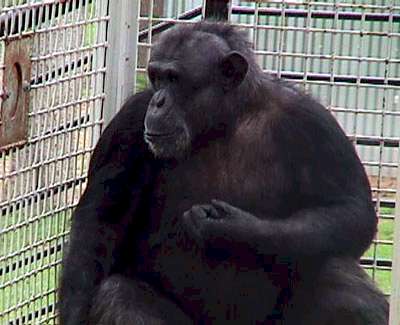
depending on your point of view). KLK-8 is believed to be involved in the physiological mediation of speech in the brain, and the coincidence of the unique abilities of humans for speech and the existence of the long form mutation raises the possibility that any such transgenic chimpanzee would have an enhanced ability to learn to speak. Classic attempts to teach other primates to speak (notably, "Nim Chimpsky," at left, in the 1970’s) demonstrated that these animals have whatever brain structures or functions are required to be capable of making connections between human words and objects (even emotions). Thus, a transgenic chimpanzee might be able to speak, and if so, verbal communication with another species could occur for the first time.
The possibilities for bridging the gap in our understanding of how another species thinks are tantalizing. Other possibilities are less felicitous, including the realization that such a talking chimpanzee is eminently patentable. U.S. law has a strict prohibition on patenting humans – the 13th Amendment banning slavery – and attempts by Jeremy Rifkin and others to patent human/animal chimeras have been thwarted by administrative decisions in the U.S. Patent and Trademark Office. (In this regard, the British Department of Health recently reversed a ban on such chimeras, although it has not yet passed the House of Commons.) There are no such prohibitions against transgenic primate patenting (transgenic animal patent claims usually recite a "non-human" animal), and given the costs of producing such a transgenic chimp, patent protection may be necessary to garner sufficient investment.
Whether the results of these studies will resemble "Dr. Doolittle" or "Planet of the Apes" is, of course, impossible to predict. However, it is likely that anyone (like author Michael Crichton) who is unconvinced about the wisdom of permitting "patenting life" will be politically opposed, and the extent to which such opposition is persuasive will determine the fate of any attempts to own a talking monkey.
Dr. Noonan has written a number of related articles for Patent Docs, including:
- "The Future of DNA Patenting," February 20, 2007
- "A DNA Patenting Thought Experiment," February 16, 2007
- "Science Fiction in The New York Times," February 13, 2007
- "The Continuing Value of Biotech Patenting," February 4, 2007
- "Anti-Patent (Sullivan?) Malice by the New York Times," January 29, 2007
- "In Support of Gene Patenting," December 7, 2006


 Patent Docs
Leave a comment